


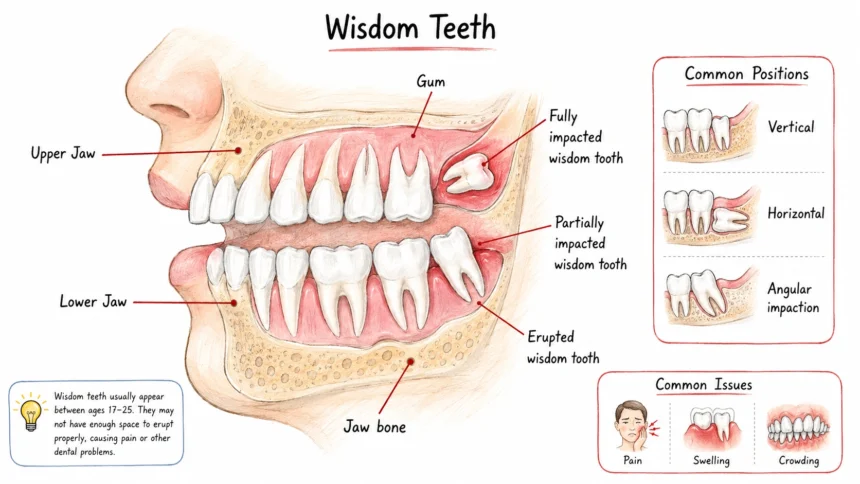
Wisdom teeth are one of the most talked about topics in dental health, yet many people still walk into their dentist’s office with very basic questions. Will I get them? Do I have to remove them? Why do they hurt so much? The reality is that wisdom teeth work very differently from person to person. Some people get all four. Some get only two. And a growing number of people never get any wisdom teeth at all throughout their entire lifetime.
This guide covers everything you need to know about wisdom teeth in plain language. No medical jargon, no confusing terms. Just clear information, practical tips, and real answers to help you understand what is happening in your mouth and what your options are.
What Exactly Are Wisdom Teeth and Why Do They Have That Name
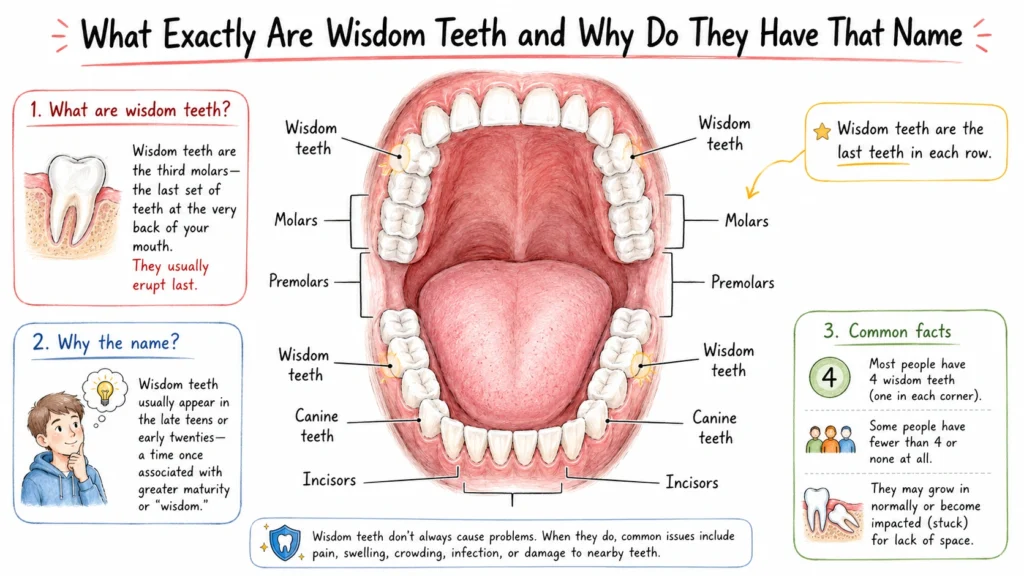
Wisdom teeth are the third set of molars that sit at the very back of your mouth. You have a total of four positions where wisdom teeth can grow, one in each corner of your jaw. They are called wisdom teeth because they tend to appear much later in life compared to your other adult teeth. Most people begin to see them come through sometime between the ages of 17 and 25, which is traditionally thought of as a time when a person gains more life experience.
The scientific name for wisdom teeth is third molars. Dentists and oral surgeons use this term in records, X-rays, and treatment notes. The word wisdom is just a nickname that has stuck around for centuries. In some other cultures and languages, they have equally interesting names. In Korean, they are called “love teeth” because they come in around the age when young people experience first love. In Japanese, they are called “oyashirazu,” which means “unknown to parents,” referring to the idea that they come in after a child has grown up and moved away from home.
| Nickname | Country or Region | Meaning Behind the Name |
| Wisdom Teeth | English-speaking countries | Appear at a wiser age |
| Love Teeth | Korea | Arrive during early romantic years |
| Oyashirazu | Japan | Unknown to parents, grown up child |
| Eyelid Teeth | Turkey | Said to cause eye pain when erupting |
| Teeth of Reason | France and Spain | Arrive with rational thought |
Does Every Single Person Get Wisdom Teeth
This is the question most people want answered first, and the honest answer is no. Not everyone gets wisdom teeth. Research published in dental and anthropology journals over the past several decades consistently shows that a significant portion of the global population never develops wisdom teeth at all.
A landmark study published in the Journal of Dental Research found that agenesis of wisdom teeth, meaning they simply never form, affects anywhere from 5 to 37 percent of people depending on the population studied and the ethnic group. That is a huge range, and it tells us one very important thing: your background and genetics play a major role in whether you get wisdom teeth.
People of Asian and Native American descent tend to have higher rates of wisdom tooth agenesis compared to people of European or African descent. Some studies looking at specific populations in Asia found that as many as 40 percent of individuals had at least one wisdom tooth missing. Meanwhile, in some European populations, the rate of complete absence sits much lower, around 5 to 10 percent.
| Population Group | Approximate Rate of Wisdom Tooth Absence | Source Type |
| Asian populations | 25 to 40 percent | Dental and anthropological studies |
| Native American populations | Up to 45 percent | Archaeological and clinical data |
| European populations | 5 to 15 percent | Clinical dental surveys |
| African populations | 1 to 5 percent | Limited but growing research |
| Mixed or global average | 20 to 25 percent | Pooled study data |
What this means practically is that if your parents or grandparents never had wisdom teeth removed, or if your dentist tells you after an X-ray that you simply do not have any forming, that is completely normal. You are not unusual. You may actually be on the leading edge of a slow evolutionary change that has been happening in the human species for thousands of years.
The Evolutionary Story Behind Why Wisdom Teeth Exist
Our ancient ancestors needed wisdom teeth very much. They ate a diet made up of raw plant material, tough roots, seeds, nuts, and uncooked meat. This type of diet required a lot of chewing, and having extra molars at the back of the jaw gave them more grinding surface to process that rough food. Their jaws were also significantly larger than the average modern jaw, which meant there was plenty of room for all those extra teeth.
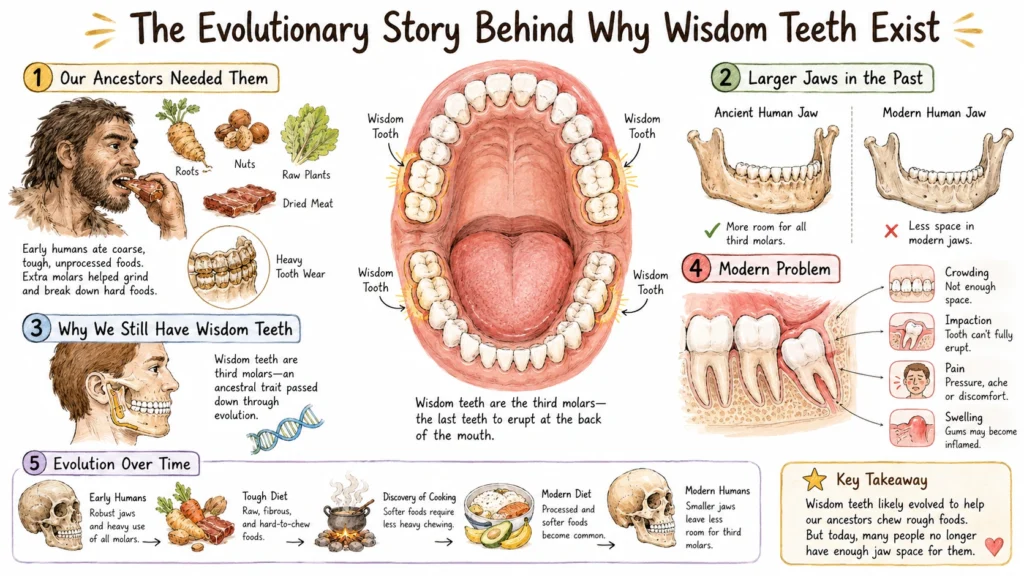
Over many thousands of years, the human diet changed dramatically. As cooking became common, food became softer. Agriculture changed what we ate entirely. Our jaws began to shrink in response to these dietary changes, and the genetic pressure to grow a full set of large molars started to ease off. The result is what we see today: many people grow wisdom teeth into jaws that are simply too small to hold them, and a growing number of people do not grow them at all.
Dr. Alan Mann, a paleoanthropologist at Princeton University, has described wisdom teeth as a relic of our evolutionary past, a kind of biological leftover that served our ancestors well but now causes more problems than benefits for many modern humans. This idea is supported by the fact that, unlike most of our other teeth, wisdom teeth have no real replacement function in a modern diet.
Tips for Understanding Your Own Evolutionary Position
Ask your parents and grandparents if they ever had wisdom teeth removed. Family history is one of the strongest indicators.
Get a panoramic dental X-ray around age 16 to see whether wisdom tooth buds are forming in your jaw.
Know that not having wisdom teeth is not a defect. It is actually considered a sign of ongoing evolutionary adaptation.
People with smaller jaw structures are more likely to experience problems if wisdom teeth do develop.
At What Age Do Wisdom Teeth Usually Come In
Wisdom teeth do not follow a strict schedule the way baby teeth do. Baby teeth tend to arrive and fall out in a fairly predictable order, but wisdom teeth can show up any time from the mid-teenage years all the way into a person’s mid-thirties, and in rare cases even later.
The most common window is between 17 and 25 years old. During this period, the tooth buds that have been slowly forming in the jawbone start to push upward toward the surface. Some people feel them coming through with mild pressure or discomfort. Others have no symptoms at all and only find out their wisdom teeth are in because a dentist mentions it at a routine check-up.
There are also people whose wisdom teeth stay partially or fully buried in the jaw for their entire life. These are called impacted wisdom teeth, and they can sit there without any problems for years, or they can slowly cause damage to neighboring teeth over time.
| Age Range | What Is Typically Happening | Should You See a Dentist |
| 14 to 16 years | Wisdom tooth buds forming inside jaw, not visible yet | Yes, for baseline X-ray |
| 17 to 21 years | Most common eruption window, teeth begin pushing through | Yes, to monitor progress |
| 22 to 25 years | Late eruption, some people see full growth here | Yes, assess for impaction |
| 26 to 35 years | Rare but possible eruption or continued impaction | Yes, X-ray recommended |
| 35 and older | Extremely rare eruption, most issues would show earlier | Yes, if new symptoms appear |
Why Some Wisdom Teeth Cause Pain and Others Do Not
Not every wisdom tooth that grows in will cause pain or problems. Some people have enough room in their jaw and their wisdom teeth come through cleanly, line up with the rest of their teeth, and function without any issues. These are called fully erupted wisdom teeth, and they can actually be useful for chewing if they are healthy and properly positioned.
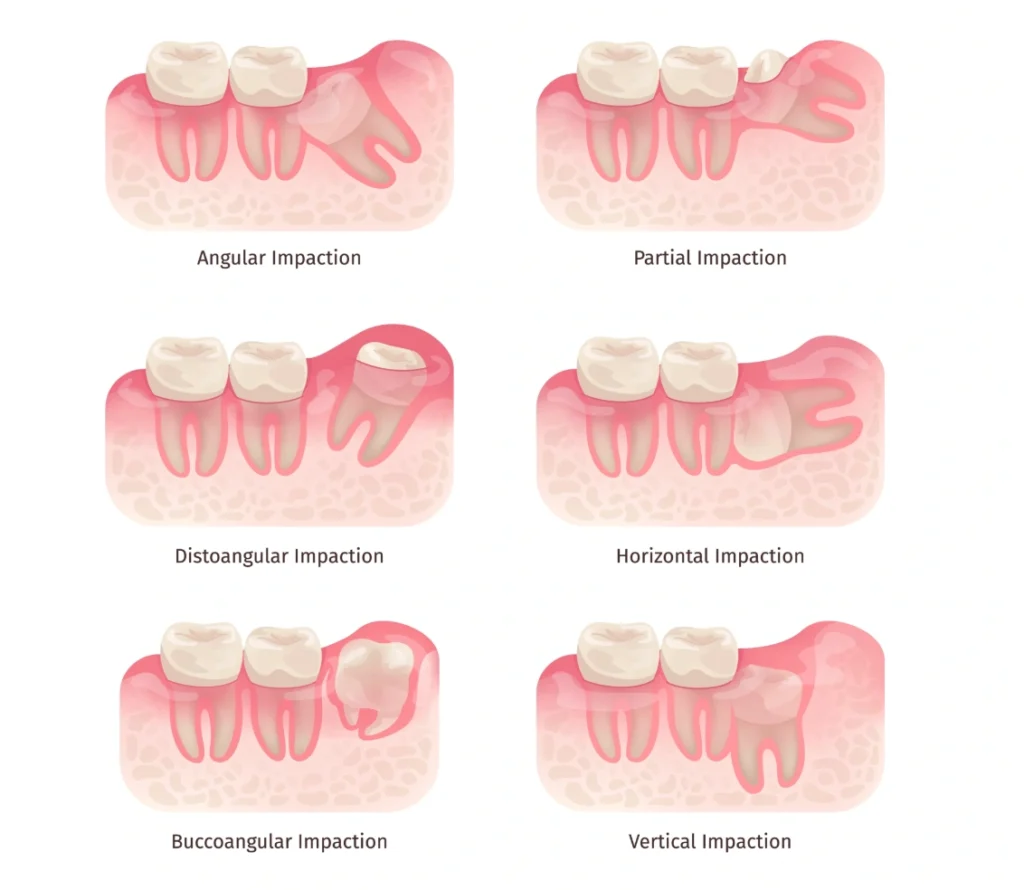
The problems begin when the jaw does not have enough space. When a wisdom tooth cannot grow in the right direction, it may grow sideways, press against the tooth next to it, or become trapped under the gum or inside the bone. This is what dentists call impaction.
There are different types of impaction depending on the angle and position of the tooth. A mesially impacted wisdom tooth grows at an angle pointing toward the front of the mouth, pressing against the second molar. A distally impacted tooth grows pointing toward the back of the throat. A horizontally impacted tooth grows completely sideways, which is typically the most painful and complicated situation. A vertically impacted tooth points in the right direction but simply cannot break through the gum because there is not enough space.
Common Signs That a Wisdom Tooth Is Causing Problems
Dull or sharp pain at the back of the jaw, especially when chewing
Swollen, tender, or red gum tissue directly behind the last molar
A feeling of pressure deep in the jaw that does not go away
Headaches that seem to originate near the ear or temple area
Difficulty opening the mouth fully without pain
A bad taste in the mouth or unpleasant smell even after brushing
Food getting caught in an area that is hard to reach with a toothbrush
One condition that specifically affects wisdom teeth that are partially erupted is called pericoronitis. This happens when the gum tissue over the partially emerged tooth gets infected. Food and bacteria become trapped under the flap of gum tissue, causing swelling, pain, and sometimes fever. Pericoronitis is one of the most common reasons dentists recommend removing a wisdom tooth even if it has not fully come through.
The Role of Genetics in Whether You Get Wisdom Teeth
Genetics is probably the single biggest factor in determining whether you will have wisdom teeth and how they will behave when they arrive. This is not just about whether you have them at all, but also about how many you get, whether they grow in straight, and how large your jaw is relative to the size of the teeth.
Researchers studying the genetics of wisdom teeth have found connections to specific genes that control tooth development. One gene called PAX9 has been shown to play a role in whether third molars form during development. Variations in this gene are more common in people who never develop wisdom teeth. Another gene, MSX1, is also associated with tooth number and size.
A 2016 study published in the American Journal of Physical Anthropology looked at wisdom tooth agenesis across families and found strong evidence for heritability. If both of your parents lacked wisdom teeth, you have a much higher likelihood of also being missing one or more. If one parent had them and one did not, you might end up somewhere in between, perhaps having two wisdom teeth instead of four.
Genetic and Family-Based Tips
Ask both parents whether they had their wisdom teeth removed or whether they were simply absent.
If one parent never had wisdom teeth, tell your dentist, as this may affect their monitoring approach.
Siblings often have similar wisdom tooth patterns, but it is not guaranteed due to how genes mix.
Identical twins almost always share the same wisdom tooth development pattern.
Your dentist can use family history alongside X-ray evidence to make better predictions about your case.
How a Dentist Checks for Wisdom Teeth
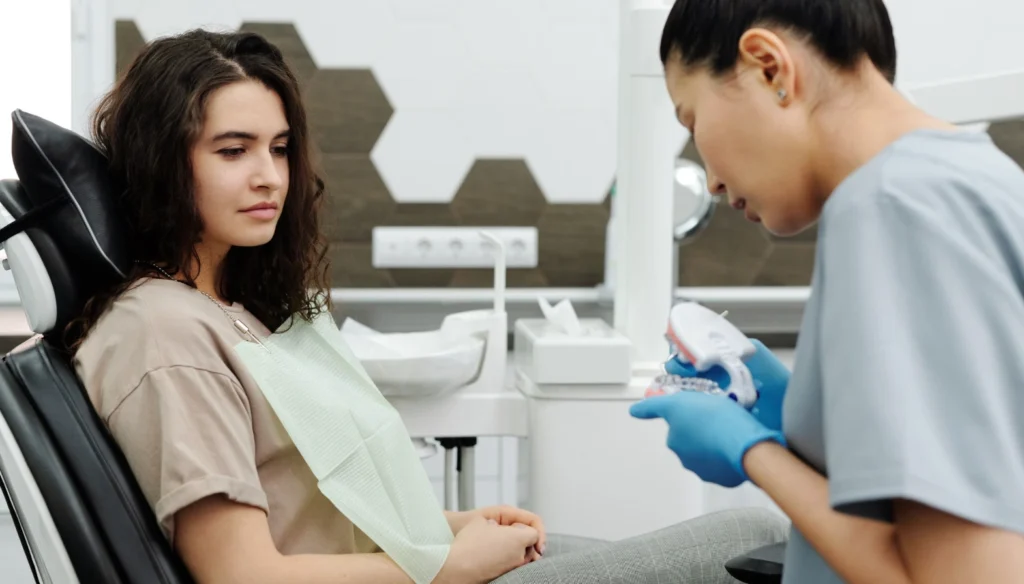
Wisdom teeth cannot be checked just by looking in your mouth, at least not in the early stages. They form deep inside the jawbone, and for most people, the first signs of their development are only visible on dental X-rays. This is why regular dental check-ups that include X-rays are so important during the teenage years and early adulthood.
The most commonly used X-ray for wisdom tooth assessment is called a panoramic X-ray, sometimes referred to as an OPG (orthopantomogram). This is the type of X-ray where the machine rotates around your entire head and produces a single flat image showing all your teeth, your jaw, your sinuses, and your nasal area. It gives the dentist a complete picture of how wisdom teeth are positioned inside the bone, whether they are pointing in a dangerous direction, how close they are to important nerves, and how much room they have to grow.
In more complex cases, especially when surgery is being planned, a dentist or oral surgeon might order a CBCT scan, which stands for cone beam computed tomography. This gives a full three-dimensional image of the jaw and teeth and allows the surgeon to see exactly where the tooth sits in relation to surrounding structures, including the inferior alveolar nerve, which runs through the lower jaw.
| Type of Imaging | What It Shows | When It Is Used |
| Bitewing X-rays | Side view of upper and lower teeth | Routine cavity check, not specific for wisdom teeth |
| Periapical X-rays | Full length of one or two teeth including roots | Checking a specific tooth with symptoms |
| Panoramic X-ray (OPG) | All teeth, full jaw, sinuses | Best initial wisdom tooth assessment |
| CBCT Scan | 3D full jaw image | Pre-surgical planning for complex extractions |
Should Wisdom Teeth Always Be Removed
This is one of the most debated questions in modern dentistry. For many years, the standard recommendation was to remove all wisdom teeth preventively, even if they were not causing problems at the time. The thinking was that it is better to remove them while a patient is young, before the roots fully develop and while healing is faster.
That view has changed somewhat over the past decade. Many dental organizations, including the American Dental Association, now take a more nuanced position. They say that not every asymptomatic impacted wisdom tooth needs to be removed. The decision should be based on a careful evaluation of the patient’s specific situation, including the position of the tooth, the risk of future problems, the proximity to nerves, and the patient’s overall health.
A 2012 report from the Cochrane Collaboration, which reviews medical evidence globally, found that there is limited scientific evidence to support the routine preventive removal of wisdom teeth that are not causing symptoms. However, the same report acknowledged that monitoring asymptomatic impacted teeth over time does carry some risk, since problems can develop slowly and without obvious symptoms until they are more serious.
The practical takeaway is that the decision should be made with your dentist or oral surgeon based on your specific X-ray findings, your symptoms, your age, and your health history. There is no single right answer that applies to everyone.
Situations Where Removal Is Strongly Recommended
The tooth is causing repeated infections or pericoronitis
The wisdom tooth is pressing against and damaging the second molar next to it
A cyst or tumor has formed around the impacted tooth
The tooth has developed decay that cannot be treated because of its position
There is evidence of bone loss around the impacted tooth
The patient is about to undergo chemotherapy or organ transplant and needs a clean dental slate
Situations Where Monitoring May Be Acceptable
The tooth is fully impacted in bone with no symptoms and stable position
The patient is older and the tooth has not moved or caused issues for many years
The tooth has fully erupted, is in a good position, and can be properly cleaned
The risk of surgery is higher than usual due to a medical condition
What Happens During Wisdom Tooth Removal
Wisdom tooth removal is one of the most common surgical procedures performed by dentists and oral surgeons worldwide. For a fully erupted wisdom tooth with straight roots, the procedure can be relatively quick and straightforward. For a deeply impacted tooth with curved roots near a nerve, it can be more involved.
Simple extractions are usually done in the dental chair under local anesthesia. The dentist numbs the area, loosens the tooth using an instrument called an elevator, and then removes it with forceps. This type of removal might take only a few minutes per tooth and the patient is awake throughout.
Surgical extractions are needed when the tooth is partially or fully impacted. The oral surgeon makes a small incision in the gum tissue, may need to remove a small amount of bone to access the tooth, and sometimes cuts the tooth into sections to make it easier to remove without damaging the surrounding tissue. Patients are usually given a choice between local anesthesia with sedation, general anesthesia, or a combination depending on their comfort level, how many teeth are being removed, and the complexity of the case.
| Recovery Stage | Typical Timeframe | What to Expect |
| First 24 hours | Day of surgery | Bleeding, gauze changes, swelling begins, rest completely |
| Days 2 to 3 | 48 to 72 hours post-op | Peak swelling, some bruising, eat only soft foods |
| Days 4 to 7 | First week | Swelling decreases, soreness reduces, stitches may dissolve |
| Week 2 | 7 to 14 days | Most people return to normal eating and daily activities |
| Full healing | 3 to 6 months | Bone fills in the socket gradually over several months |
Recovery Tips That Are Genuinely Helpful
Apply ice to the outside of the face in 20-minute intervals on the day of surgery to reduce swelling.
Sleep with your head slightly elevated for the first night to minimize swelling buildup.
Avoid straws, smoking, and spitting forcefully during the first 72 hours as this can dislodge the blood clot and cause a painful condition called dry socket.
Eat soft foods like yogurt, mashed potatoes, soup broth, scrambled eggs, and smoothies for the first week.
Gently rinse with warm salt water starting 24 hours after surgery, not immediately, to keep the area clean.
Take prescribed pain medication before the numbness wears off so you stay ahead of the discomfort.
Do not poke the area with your tongue or fingers, even though the urge to check it is very strong.
What Is Dry Socket and How Do You Avoid It
Dry socket, medically known as alveolar osteitis, is the most common complication after wisdom tooth removal. It happens when the blood clot that forms in the empty socket after extraction gets dislodged or dissolves before the wound has properly healed. This exposes the bone and nerves inside the socket directly to air, food, and saliva, causing intense pain that typically starts two to four days after the surgery.
The pain from dry socket is distinctly different from normal post-surgical soreness. It is described as a deep, throbbing ache that can radiate up toward the ear and along the jaw. Many patients say it is significantly worse than the extraction itself. Dry socket affects roughly 2 to 5 percent of all extractions, but the rate jumps to around 20 percent for impacted lower wisdom teeth specifically.
Certain factors increase your risk of dry socket. Smoking is the biggest one. The suction from inhaling smoke can pull out the blood clot, and the chemicals in tobacco also interfere with healing. Women who take oral contraceptives have a slightly higher risk as well, likely related to hormone effects on clotting. People who have had dry socket before are more likely to get it again.
Dry Socket Risk Factors at a Glance
Smoking or using any form of tobacco in the days following surgery
Using a straw within the first 72 hours
Rinsing your mouth too forcefully too soon after surgery
Having had dry socket in a previous extraction
Poor oral hygiene before the procedure
Taking oral contraceptives, which may affect clotting
Drinking carbonated beverages too soon after surgery
If dry socket does occur, your dentist will clean out the socket and pack it with a medicated dressing that reduces pain almost immediately. You may need to return every few days for dressing changes while the area heals. It is not dangerous, but it is painful and extends your recovery significantly.
Can Wisdom Teeth Affect Your Other Teeth and Jaw
Yes, in several ways. When a wisdom tooth pushes against the second molar, it creates pressure that can cause that neighboring tooth to shift, crack, or even develop decay on the side surface where the two teeth meet. This type of decay is particularly tricky because it sits between two teeth and is very hard to see or treat without first dealing with the wisdom tooth.
There is also an ongoing debate about whether wisdom teeth contribute to crowding in the front of the mouth. Many orthodontists used to tell patients after braces that their wisdom teeth would cause their newly straightened front teeth to shift. Modern research does not fully support this claim. Studies using patients who had wisdom teeth removed versus those who did not show that front tooth crowding develops similarly in both groups over time. The crowding is thought to be more related to natural jaw growth patterns as people age rather than wisdom tooth pressure.
However, wisdom teeth can contribute to other jaw-related issues. Repeated infections from a partially erupted wisdom tooth can spread to surrounding jaw tissue. In very rare cases, cysts that develop around impacted wisdom teeth can grow large enough to weaken the jawbone itself. These are serious situations that require prompt surgical treatment.
| Potential Effect | How Common Is It | What It Means for You |
| Damage to second molar | Relatively common with mesially impacted teeth | Reason for earlier removal in many cases |
| Gum disease around wisdom tooth | Common in partially erupted teeth | Risk increases with age if left in place |
| Tooth crowding in front | Not strongly supported by current research | Should not be the sole reason for removal |
| Cyst formation around impacted tooth | Uncommon but serious if it occurs | Requires surgical removal of cyst and tooth |
| Jaw infection spreading | Rare but potentially dangerous | Requires immediate dental or hospital treatment |
Wisdom Teeth in Older Adults: What Changes After 35
Most wisdom tooth problems are identified and treated in the late teens and twenties. But some people reach their thirties or forties with wisdom teeth still present and never having caused significant issues. The question then becomes: should they still be removed, and if so, does being older make it more complicated?
The honest answer is that removing wisdom teeth in older adults is generally more complex than doing so in younger people. The roots of wisdom teeth become longer and more firmly embedded in the jawbone as a person ages. The bone itself becomes denser and less flexible. Healing also tends to take longer. The risk of complications like nerve damage, prolonged bleeding, and slower socket healing increases somewhat with age.
That said, older adults can and do have wisdom tooth extractions performed safely every day. The decision comes down to whether the risk of leaving the tooth in place is greater than the risk of removing it. If a wisdom tooth in a 45-year-old has been stable, has not caused infections, and is not damaging neighboring teeth, a dentist might reasonably recommend leaving it alone with regular monitoring. If it starts causing problems, removal is still an option, just one that is approached with more care and preparation.
What Happens If You Never Remove a Problematic Wisdom Tooth
Not everyone acts quickly when wisdom tooth problems arise. Some people delay treatment because of cost, dental anxiety, lack of access to care, or simply hoping the pain will go away. It is worth knowing what can happen over time when a problematic wisdom tooth is left untreated.
In the short term, repeated flare-ups of pericoronitis may come and go. Each episode brings pain, swelling, and sometimes difficulty swallowing or opening the jaw. These flare-ups can be managed with antibiotics and antiseptic rinses, but they will likely keep coming back as long as the tooth remains.
Over the long term, an impacted tooth that is pressing against the second molar can cause irreversible damage to that tooth’s root, requiring expensive restorative treatment or even loss of the second molar itself. Decay between the wisdom tooth and the second molar can spread. In rare cases, a cyst around the wisdom tooth can grow slowly over years and cause significant bone destruction before it becomes obvious on a standard X-ray.
Signs That Waiting Is No Longer a Good Option
You have had two or more infections in the same area within a single year
Pain is now affecting your ability to eat normal food or sleep through the night
Your dentist has identified decay or damage on the tooth next to your wisdom tooth
Swelling around the wisdom tooth has spread toward your neck or under your jaw
You have a persistent bad taste or smell that does not improve with brushing
Wisdom Teeth and Overall Health: A Connection Worth Knowing
The mouth is not separate from the rest of the body, and problems with wisdom teeth can have effects that go beyond the jaw. Chronic oral infections are linked to systemic inflammation, which in turn is associated with a range of health conditions including cardiovascular issues and diabetes complications. While a wisdom tooth infection is unlikely to cause a heart attack by itself, maintaining good oral health is genuinely connected to your overall body health in ways that medical researchers continue to document.
People who have poorly controlled diabetes tend to heal more slowly from dental extractions and are more prone to post-surgical infections. People taking blood thinners require careful management before any extraction to minimize bleeding risks. Individuals who are pregnant should ideally have wisdom tooth issues addressed either before becoming pregnant or, if necessary during pregnancy, during the second trimester when it is considered safest.
The connection between oral health and systemic health is one reason dentists are encouraged to take a full medical history before any extraction procedure. Conditions like heart valve disorders, certain bone diseases, and a history of radiation to the jaw area can all significantly affect how a wisdom tooth removal is planned and carried out.
| Health Condition | How It Relates to Wisdom Teeth |
| Diabetes | Slower healing, higher infection risk after removal |
| Blood thinning medications | Increased bleeding risk, may need dose adjustment |
| Osteoporosis medications (bisphosphonates) | Risk of osteonecrosis of the jaw, requires special management |
| Pregnancy | Safest to treat in second trimester if needed, avoid elective removal |
| Heart valve conditions | May require antibiotics before procedure to prevent bacterial spread |
| Prior jaw radiation | Significantly reduced blood supply to bone, very high complication risk |
The Cost of Wisdom Tooth Treatment and What to Expect
Cost is a real factor in dental decision-making, and wisdom tooth removal is not cheap, particularly for impacted teeth that require oral surgery. The price varies significantly depending on where you live, whether you have dental insurance, whether the procedure is simple or surgical, and whether you choose local anesthesia or general anesthesia.
In the United States, a simple erupted wisdom tooth extraction might cost between 75 and 200 dollars per tooth at a general dentist. A surgically impacted wisdom tooth removed by an oral surgeon, especially under general anesthesia, can cost anywhere from 300 to 800 dollars per tooth or more. Removing all four at once under general anesthesia can sometimes run between 1,500 and 3,000 dollars total without insurance.
Dental insurance often covers a portion of wisdom tooth removal, especially if the procedure is medically necessary due to infection, impaction, or damage to neighboring teeth. It is worth calling your insurance company before scheduling the procedure to find out your coverage details, deductible, and any waiting periods.
For people without insurance, asking about payment plans, looking into dental schools where supervised students perform extractions at reduced cost, or seeking community dental clinics can make the procedure more affordable. Some areas also have free dental care days organized by local dental associations.
Questions to Ask Your Dentist About Your Wisdom Teeth
Going to a dental appointment without knowing what to ask can leave you feeling confused about your options. Having a clear set of questions ready makes the conversation much more productive and helps you make a better decision about your own care.
Important Questions Worth Asking
Can I see my X-ray and can you explain exactly what you are seeing with my wisdom teeth?
Are my wisdom teeth actively causing a problem right now or is this more of a future risk?
If I choose to wait, what signs should I watch for that would mean I need to come back sooner?
Is this extraction something you can do here or do I need to be referred to an oral surgeon?
What type of anesthesia would you recommend for my particular case?
How long will recovery take and are there any restrictions on eating, work, or exercise?
What is the risk of nerve damage in my specific situation?
Do I need all four removed at once or can we do one or two at a time?
Will my dental insurance cover this and can you help me understand the billing?
A Final Word on Living With or Without Wisdom Teeth
There is no single story when it comes to wisdom teeth. Some people sail through life without ever giving them a second thought. Others face painful extractions in their twenties and never think about them again. A smaller number deal with complications, repeated infections, or delayed treatment that makes things more difficult than they needed to be.
The most important thing you can do is stay informed and stay current with your dental check-ups. Wisdom teeth are easiest to manage when they are caught early, before problems develop. A panoramic X-ray in your mid-teens gives your dentist the information needed to plan ahead. An honest conversation about your symptoms, your family history, and your lifestyle helps your dentist give you advice that actually fits your situation.
Not having wisdom teeth does not mean anything is wrong with you. Having them and needing them removed does not mean you are unusual. And keeping them because they came in cleanly and are healthy is also a perfectly reasonable outcome. The goal of all dental care is to keep your mouth healthy and functioning well for your entire life, and that goal looks different for every person.
Understanding what wisdom teeth are, why they exist, how they develop, and what your options are puts you in a much stronger position to have a productive conversation with your dentist and make choices that are right for your health.
Medical Disclaimer
This article is written for general informational purposes only and does not constitute medical or dental advice. It is not intended to replace a professional consultation with a licensed dentist or oral surgeon. If you are experiencing pain, swelling, or any symptoms related to your wisdom teeth, please seek professional evaluation promptly. Treatment decisions should always be made in partnership with a qualified dental professional who can assess your individual situation.