


Can Wisdom Teeth Grow Back After Removal
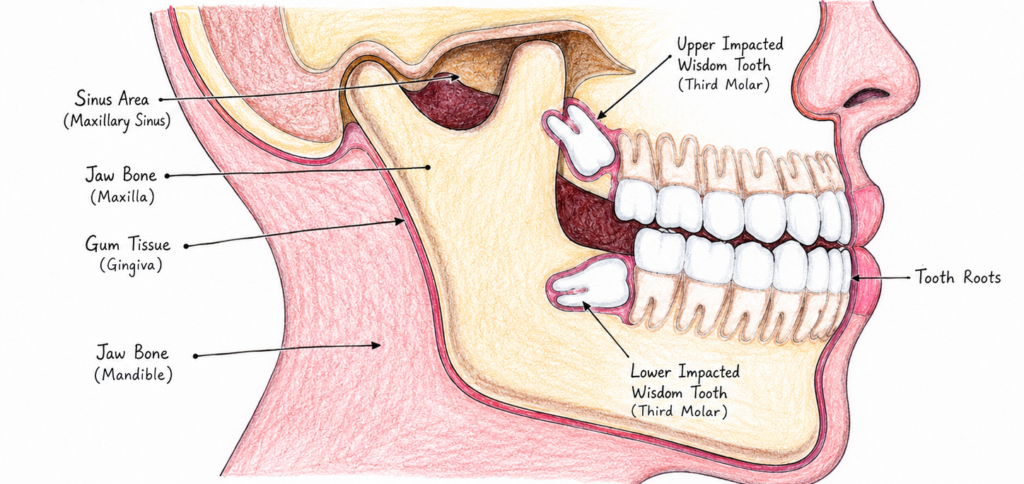
Wisdom teeth can cause a lot of confusion. Many people get them removed, heal for a few months, and then later feel something hard, sore, sharp, or swollen at the back of the mouth.
The clear answer is no, a wisdom tooth that has been fully removed does not grow back. Teeth are not like hair or nails. Once a full tooth is removed from the jaw, the body does not make the same tooth again. Still, there are several reasons why it may feel like a wisdom tooth is coming back after removal. Some people may have extra teeth. Some may feel bone pieces coming through the gum during healing. Others may have pain from the second molar, gum infection, jaw stiffness, or a small leftover root.
This article explains the topic in simple words. It also shows when the feeling is normal, when it is not normal, and when you should call a dentist.
| Main question | Simple answer |
|---|---|
| Can wisdom teeth grow back after full removal? | No, the same wisdom teeth cannot grow back |
| Can a new tooth appear in that area later? | Rarely, yes, if the person has an extra tooth |
| Can the gum feel like a tooth is coming back? | Yes, healing bone or swelling can feel that way |
| Should you ignore pain after removal? | No, lasting or growing pain needs a dental check |
| Is an X-ray useful? | Yes, it can show if there is a tooth, root, bone piece, or other issue |
The Simple Answer Most People Need First
A wisdom tooth cannot grow back after it has been fully removed. When a dentist or oral surgeon removes the crown and roots of the tooth, that tooth is gone. Your body does not keep a backup copy of the same tooth. It cannot build the same wisdom tooth again from nothing.
The confusion starts because the back of the mouth is a busy healing area. The gum closes. Bone reshapes. Small hard edges may show up. Nearby teeth may shift slightly. The second molar may become sensitive. Food may get trapped near the healing area. All of these can feel like a new wisdom tooth.
| What the patient feels | What it may actually be |
|---|---|
| A hard bump under the gum | Healing bone, scar tissue, or an extra tooth |
| A sharp white piece coming out | Bone fragment or small tooth piece |
| Pain behind the last molar | Gum infection, food trapping, dry socket, or jaw soreness |
| Pressure like teething | Bone healing, swelling, or movement near the second molar |
| A tooth-like shape on an X-ray | Extra tooth or retained root |
Quick signs that it is probably not a new wisdom tooth
Most hard spots after removal are not new wisdom teeth. The body heals in stages, and the gum can feel uneven for a while. A true tooth has a structure, root shape, and position that a dentist can confirm on an X-ray.
Common signs that the feeling may be healing related include:
- The hard area is small and sharp
- The gum is still closing
- The area feels rough but not shaped like a full tooth
- The feeling started soon after removal
- Pain comes and goes with chewing
- Food gets stuck near the back tooth
- The gum looks irritated but no tooth crown is visible
| Timing after removal | More likely reason |
|---|---|
| First few days | Normal soreness, swelling, clot healing |
| First few weeks | Gum closing, bone edge, food irritation |
| After a few months | Bone remodeling, scar tissue, second molar issue |
| After a few years | Extra tooth, retained root, gum disease, decay, jaw issue |
Why Wisdom Teeth Do Not Grow Back Like Hair
A tooth forms from a tooth bud before it appears in the mouth. By the time a wisdom tooth is ready to come in, its crown has already formed under the gum. The roots continue to grow as the tooth develops. Once the tooth is removed, the body does not restart that tooth-making process.
This is different from hair, skin, or nails. Those tissues keep growing because they have living growth centers that continue making new cells. Adult teeth are different. Humans normally get baby teeth first, then adult teeth. After adult teeth are lost, natural replacement does not happen.
Wisdom teeth are adult teeth. They are also called third molars. They sit behind the second molars at the very back of the mouth. If they are fully removed, the same third molars are gone for life.
| Body part | Can it grow again naturally? | Reason |
|---|---|---|
| Hair | Yes | Hair follicles keep making hair |
| Nails | Yes | Nail roots keep growing nail tissue |
| Skin surface | Yes | Skin renews itself |
| Baby teeth | Replaced once | Adult teeth come after baby teeth |
| Adult teeth | No | No natural third set of teeth forms |
| Removed wisdom teeth | No | The tooth and roots are removed |
Why the back gum can still feel active
The back gum may feel active because the extraction site is not just a hole in soft tissue. It includes gum, bone, blood vessels, nerves, and nearby tooth roots. Healing can feel strange, especially if the tooth was impacted or removed in pieces.
- The gum slowly becomes flatter
- Swelling reduces week by week
- Chewing becomes easier
- Bad taste goes away
- Jaw opening improves
- The hard spot becomes smaller or less sharp
| Feeling | Usually normal when | Needs a dentist when |
|---|---|---|
| Mild pressure | It slowly improves | It keeps getting worse |
| Small rough edge | It is not painful | It cuts the tongue or cheek |
| Gum soreness | It improves with care | It comes with pus or bad smell |
| Jaw stiffness | It improves daily | You cannot open well |
| Mild bleeding | It stops quickly | It does not stop with pressure |
Extra Wisdom Teeth
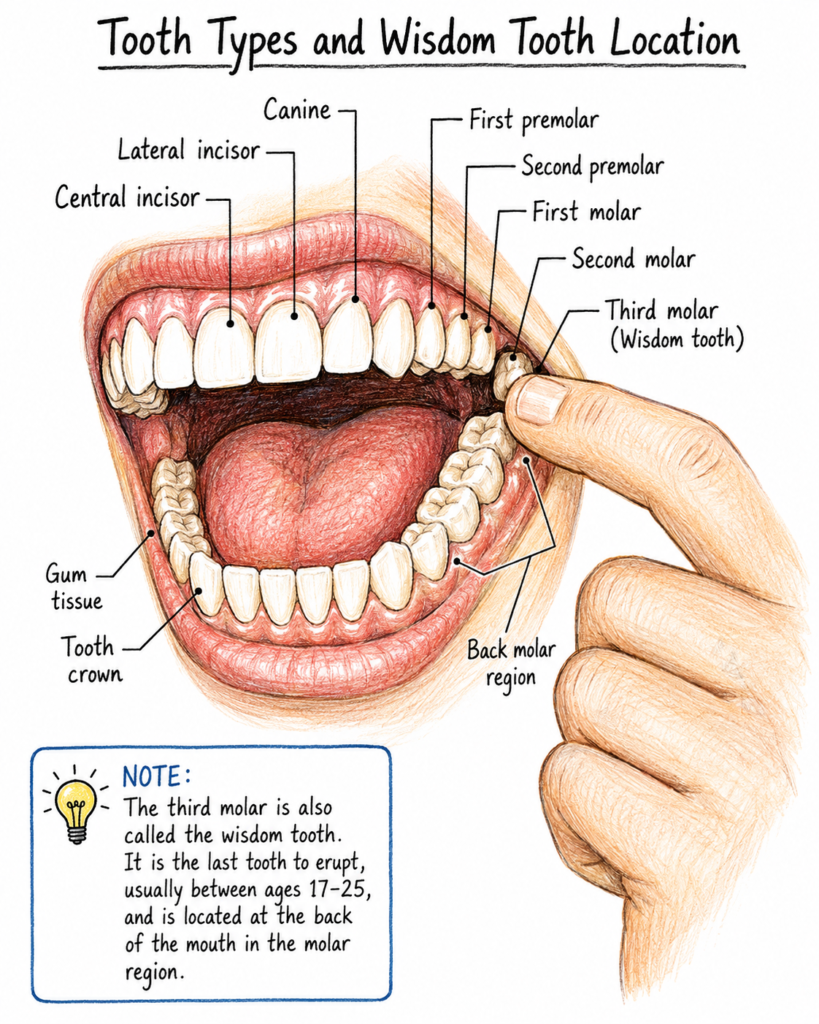
Some people have more than the usual number of teeth. These are called extra teeth, or supernumerary teeth. If an extra tooth forms behind or near the removed wisdom tooth area, it may look like a wisdom tooth has grown back. In reality, it is not the same tooth returning. It is another tooth that was already developing or was hidden before.
Extra wisdom teeth are not common. Many people have four wisdom teeth, but some have fewer and some have more. A person may not know about an extra tooth until a dental X-ray shows it. Sometimes it stays under the gum. Sometimes it starts moving into the mouth later.
This is one of the main reasons a person may honestly feel, “My wisdom tooth came back.” The better wording is, “An extra tooth may have appeared after the original wisdom tooth was removed.”
| Situation | Meaning |
|---|---|
| Same tooth grows back | Not possible after full removal |
| Extra tooth appears later | Possible but uncommon |
| Tooth was not removed fully | Possible in some cases |
| Roots were left on purpose | Possible after coronectomy |
| Root or bone piece comes out | Possible during healing |
How dentists confirm an extra tooth
A dentist cannot confirm an extra tooth by touch alone. The back of the mouth can trick both the patient and the eye. A dental X-ray gives a clearer view. In some cases, a panoramic X-ray or a three-dimensional scan may be needed.
- If there is a tooth-shaped structure under the gum
- If roots are present
- If the shape looks like a molar
- If the tooth is pushing against the second molar
- If there is a cyst or infection around it
- If the tooth needs removal or only monitoring
| Test or check | What it helps show |
|---|---|
| Visual exam | Gum swelling, opening, infection, visible tooth |
| Touch exam | Sharp spot, hard bump, sore area |
| Small dental X-ray | Nearby tooth decay or root issues |
| Panoramic X-ray | Whole wisdom tooth area |
| Cone beam scan | Detailed root, nerve, and bone position |
Bone Fragments Can Feel Like New Teeth
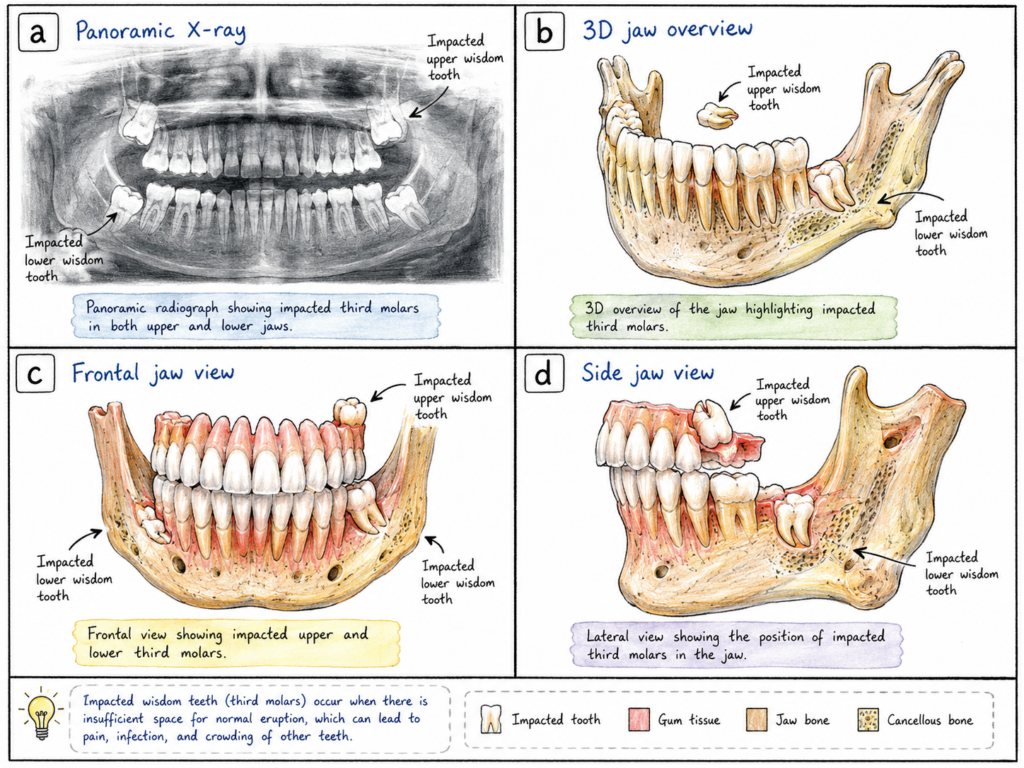
One of the most common reasons for a “tooth growing back” feeling is a small bone fragment. After a wisdom tooth is removed, the bone around the socket heals and changes shape. Sometimes a tiny piece of bone works its way through the gum. This can feel sharp, hard, and tooth-like.
A bone fragment is not a new wisdom tooth. It is usually a small piece of bone from the socket area. Some come out on their own. Others need a dentist to smooth or remove them. You should not try to pull or cut it at home because that can cause bleeding, infection, or more pain.
Dentist style note: “A sharp piece after extraction is often bone, not a new tooth. The safest check is a dental visit, because the right treatment depends on what the hard piece is.”
| Bone fragment sign | What it may feel like |
|---|---|
| Sharp edge | Like a tiny tooth tip |
| White or pale color | Like enamel, but usually rougher |
| Gum soreness | The gum may rub against it |
| Tongue irritation | The tongue keeps touching it |
| Comes weeks later | Bone can move outward as healing continues |
What to do if a sharp piece appears of wisdom teeth extraction step?
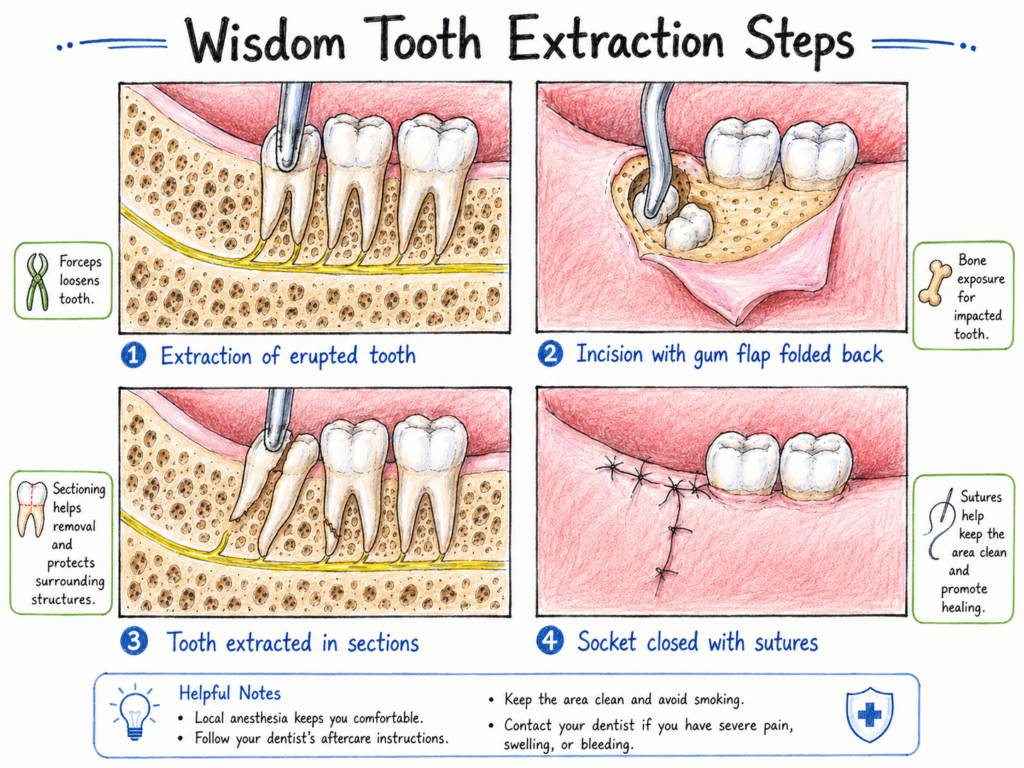
The best step is to call the dental office that removed the tooth. They know how difficult the extraction was and what was done during surgery. They may ask you to come in for a quick check.
Helpful care steps include:
- Keep the area clean with gentle rinsing if your dentist allows it
- Do not pick at the gum
- Do not pull the hard piece
- Avoid hard food that hits the area
- Call the dentist if the sharp piece hurts
- Ask for an X-ray if the problem keeps returning
| Do | Avoid |
|---|---|
| Rinse gently as advised | Digging with fingers |
| Eat softer foods if sore | Pulling the piece out |
| Keep brushing other teeth | Using sharp tools |
| Call your dentist | Waiting if pain increases |
| Ask what the piece is | Guessing based only on feel |
Retained Roots Can Cause Confusion
Sometimes a wisdom tooth is difficult to remove because the roots are curved, close to a nerve, near the sinus, or locked in bone. In some cases, a tiny root piece may remain. This can happen by accident, or it may be done on purpose when removing the root could cause more harm than leaving it.
A retained root does not mean the wisdom tooth grew back. It means part of the original tooth root stayed in the jaw. Many small retained root pieces cause no problem. Some may need monitoring. A few can become infected or move toward the surface.
There is also a procedure called coronectomy. In that procedure, the crown of the wisdom tooth is removed, but the roots are left in place on purpose. This may be done when the roots are very close to an important nerve. If a person had this procedure, they may later feel pressure or movement from the roots.
| Cause | Simple meaning |
|---|---|
| Tiny root left by accident | Small part of the old tooth remains |
| Root left on purpose | Dentist chose safer option in a high-risk case |
| Coronectomy | Crown removed, roots left |
| Root moves later | Root may shift slightly during healing |
| Root gets infected | Dentist may need to treat or remove it |
Questions to ask if roots may be involved
If you feel pain after removal and suspect a root issue, ask clear questions. This helps you understand your case without panic.
- Was the whole tooth removed?
- Were any roots left on purpose?
- Did I have a coronectomy?
- Is the hard area bone or tooth root?
- Do I need an X-ray?
- Is the root close to a nerve or sinus?
- Should we watch it or remove it?
| Question | Why it helps |
|---|---|
| Was any root left? | Clears up confusion |
| Do I need imaging? | Shows what is under the gum |
| Is there infection? | Helps decide treatment |
| Is it safe to remove? | Checks nerve or sinus risk |
| Can we monitor it? | Avoids needless surgery |
Pain After Removal Is Not Always From the Wisdom Tooth Area
A person may feel pain where the wisdom tooth used to be, but the cause may come from another place. The second molar, jaw joint, gum tissue, chewing muscles, or sinus can refer pain to the back of the mouth. This means the pain feels like it is in one spot, but the real source may be nearby.
For example, the second molar sits right in front of the wisdom tooth. If it has decay, a cracked filling, gum pocket, or root irritation, it can feel like the old wisdom tooth area is hurting. The patient may think the wisdom tooth returned, but the issue is actually the tooth beside the empty space.
| Pain source | How it can feel |
|---|---|
| Second molar decay | Deep ache near the old wisdom tooth area |
| Gum infection | Swelling, bad taste, soreness |
| Jaw joint strain | Pain when opening or chewing |
| Sinus pressure | Upper back tooth pain |
| Food trapping | Tender gum behind the last molar |
| Bone healing | Hard or sore spot in the socket area |
Clues that the second molar may be the real problem
The second molar is easy to blame late because attention often stays on the removed wisdom tooth. Still, the second molar does a lot of chewing work and may need care after wisdom tooth removal.
Common clues include:
- Pain when biting on one side
- Sensitivity to cold or sweet food
- Food getting stuck behind the second molar
- Gum bleeding near the back tooth
- A bad taste from one spot
- Pain that returns months after full healing
- Pain that feels higher or lower than the old socket
| Clue | Possible meaning |
|---|---|
| Cold sensitivity | Decay, exposed root, or filling issue |
| Pain on biting | Crack, gum issue, or root problem |
| Bad taste | Food trapping or infection |
| Gum bleeding | Gum pocket or irritation |
| Pain months later | New dental issue, not normal healing |
Dry Socket Is Different From a Tooth Growing Back
Dry socket is a painful healing problem that can happen after a tooth is removed. It happens when the blood clot in the socket is lost or does not form well. The clot protects the bone while the socket heals. When that clot is missing, the area can become very painful.
Dry socket does not mean a wisdom tooth is growing back. It usually happens soon after removal, often within the first few days. The pain may feel strong, deep, and hard to control with normal pain medicine. There may also be a bad taste or bad smell.
| Dry socket point | Simple meaning |
|---|---|
| Timing | Usually early after removal |
| Pain | Often strong and deep |
| Cause | Blood clot problem |
| Tooth growing back? | No |
| Treatment | Dentist cleans and protects the socket |
When pain sounds like dry socket
Dry socket should be checked by a dentist. It is treatable, but home care alone may not be enough.
- Pain that gets worse instead of better
- Pain that starts a few days after removal
- Bad taste from the socket
- Bad smell from the mouth
- Pain moving to the ear or jaw
- Empty-looking socket
- Pain medicine not helping much
| Normal healing pain | Possible dry socket pain |
|---|---|
| Improves over time | Gets worse after a few days |
| Mild to moderate | Strong and deep |
| Helps with medicine | Medicine may not help much |
| No bad smell | Bad taste or smell may happen |
| Gum slowly closes | Socket may look empty |
Why Some People Think Their Wisdom Teeth Returned Years Later
Years after wisdom teeth are removed, a person may feel new pain at the back of the mouth. Since the wisdom teeth were once there, it is natural to blame them. But years later, the most likely causes are new dental or gum problems, not the same tooth growing back.
The mouth changes with age. Fillings wear down. Gum pockets can form. Teeth can shift. A person may start grinding their teeth. The second molar may develop decay on the back surface, especially because that area is hard to clean. An extra tooth is possible, but it is not the usual reason.
| Years-later symptom | More likely cause |
|---|---|
| Pain behind last molar | Gum pocket or food trapping |
| Tooth sensitivity | Second molar decay or root exposure |
| Jaw ache | Grinding or jaw joint strain |
| Swelling | Gum infection or abscess |
| Hard bump | Bone shape, cyst, extra tooth, or root piece |
| Bad taste | Food, gum infection, or drainage |
A practical way to think about old extraction pain
Think of the old wisdom tooth area as a neighborhood, not a single empty space. Pain in that area can come from many nearby structures. The old socket may be healed, but the second molar, gum, bone, and jaw joint still need care.
- Check if food gets trapped behind the last tooth
- Notice if pain happens when biting
- Notice if cold drinks cause pain
- Look for swelling or redness
- See if pain is worse in the morning
- Track if the pain comes with sinus pressure
- Ask for an X-ray if pain keeps returning
| Pattern | Possible clue |
|---|---|
| Worse after meals | Food trapping |
| Worse with cold drinks | Tooth decay or root sensitivity |
| Worse in morning | Grinding or jaw clenching |
| Worse when opening mouth | Jaw joint or muscle strain |
| Comes with swelling | Infection needs dental care |
What an X-Ray Can Show
An X-ray is one of the best ways to answer the “did it grow back?” question. The dentist can see whether there is a tooth, root, bone issue, cyst, decay, or gum problem. Without imaging, even a skilled dentist may not know the full reason for pain or pressure.
A simple dental X-ray may be enough if the problem is near the second molar. A panoramic X-ray may be better if the dentist wants to see the full wisdom tooth area. A three-dimensional scan may be used when roots, nerves, or sinuses need a closer look.
| Imaging type | Best for |
|---|---|
| Bitewing X-ray | Decay near back teeth |
| Periapical X-ray | Tooth roots and nearby bone |
| Panoramic X-ray | Whole jaw and wisdom tooth areas |
| Cone beam scan | Detailed bone, nerve, sinus, and root position |
| Follow-up X-ray | Checking changes over time |
What to bring to the dental visit
If you had wisdom teeth removed somewhere else, old records can help. The new dentist can compare what was removed, what was left, and what has changed.
- Date of wisdom tooth removal
- Name of the clinic or surgeon
- Old X-rays if available
- Notes about difficult removal
- Whether you had stitches
- Whether you were told roots were left
- Any past infection or dry socket
- Current symptoms and timing
| Information | Why it matters |
|---|---|
| Old X-ray | Shows original tooth position |
| Surgery notes | Shows if roots were left |
| Current X-ray | Shows what is happening now |
| Symptom timeline | Helps separate healing from new problems |
| Medicine history | Helps safe treatment planning |
Symptoms You Should Not Ignore
Mild soreness can happen during healing, but some symptoms need quick dental advice. Pain that gets worse, swelling that spreads, fever, pus, trouble opening your mouth, or trouble swallowing should not be ignored.
A wisdom tooth cannot grow back, but infection can grow. That is why symptoms matter more than the idea of a tooth returning. If the area looks swollen, tastes bad, or keeps bleeding, it needs attention.
| Symptom | Why it matters |
|---|---|
| Swelling that gets bigger | Possible infection |
| Bad taste or pus | Possible drainage |
| Fever or feeling unwell | Infection may be spreading |
| Trouble opening mouth | Jaw muscle or infection issue |
| Trouble swallowing | Needs urgent care |
| Bleeding that will not stop | Needs dental advice |
| Severe pain | Not normal if it worsens |
When to call the dentist
Call a dentist if the pain is not improving or if the area looks infected. It is better to check early than wait until the problem becomes harder to treat.
- Pain getting worse after initial healing
- Swelling in the gum or cheek
- Bad smell from the socket
- Bleeding that keeps coming back
- Sharp piece cutting the tongue
- Fever or feeling sick
- Numbness that does not improve
- New tooth-like lump under the gum
| Situation | Best action |
|---|---|
| Mild soreness after surgery | Follow aftercare instructions |
| Sharp hard piece | Book a dental check |
| Strong pain after a few days | Ask about dry socket |
| Pain years later | Check second molar and gum |
| Swelling with fever | Seek urgent dental care |
| Trouble breathing or swallowing | Seek emergency help |
How Healing Can Trick Your Tongue
The tongue is very sensitive. It can notice tiny changes that your eyes cannot see. A small ridge, stitch, bone edge, or gum fold can feel much larger than it really is. This is why many people keep touching the area and become more worried.
The back of the mouth also heals unevenly. The gum may close from the sides. The bone may round itself off slowly. The socket may feel like a dip before it fills. None of this means the wisdom tooth is returning.
| Tongue feeling | Possible reason |
|---|---|
| Sharp point | Bone edge or small fragment |
| Raised ridge | Healing gum or scar tissue |
| Hollow dip | Socket still filling |
| Soft flap | Gum tissue healing |
| Hard lump | Bone shape, root, or extra tooth |
Tips to avoid making the area worse
Constant touching can slow healing and irritate the gum. It can also bring bacteria into the area.
- Do not press the area with your tongue all day
- Do not poke it with a toothpick
- Keep brushing gently
- Use dentist-approved rinsing
- Avoid hard chips, seeds, and sharp foods while sore
- Chew on the other side for a short time if needed
- Book a check if the hard spot does not settle
| Habit | Why it helps |
|---|---|
| Gentle cleaning | Reduces bacteria |
| Soft food during soreness | Less rubbing on gum |
| Less tongue checking | Less irritation |
| Dental review | Confirms the cause |
| X-ray when needed | Removes guessing |
Food Trapping Behind the Second Molar
After a wisdom tooth is removed, the gum shape behind the second molar may change. Sometimes a small pocket or dip remains for a while. Food can get stuck there and cause soreness, bad taste, and pressure. This can feel like something is growing in the back of the mouth.
Food trapping is common because the area is hard to see and clean. Even small bits of food can irritate the gum. If bacteria build up, the gum can become swollen and painful.
| Food trapping sign | What you may notice |
|---|---|
| Bad taste after meals | Food stuck near gum |
| Gum soreness | Irritated tissue |
| Pressure behind molar | Packed food or swelling |
| Bleeding when brushing | Gum inflammation |
| Bad breath | Bacteria and trapped debris |
Cleaning tips for the back molar area
Do not start strong rinsing or irrigation right after surgery unless your dentist says it is safe. After the early healing stage, gentle cleaning may help. Your dentist may show you how to clean the area without harming the gum.
- Brush the last molar carefully
- Angle the toothbrush toward the back gum
- Use floss if the contact allows it
- Rinse gently with warm salt water if advised
- Ask your dentist about a syringe only when healing is ready
- Avoid forcing water into a fresh socket
- Keep routine dental cleanings
| Cleaning tool | Use with care |
|---|---|
| Soft toothbrush | Good for daily cleaning |
| Floss | Useful between teeth |
| Warm salt water | Gentle support when allowed |
| Water syringe | Only when dentist says it is safe |
| Interdental brush | Only if it fits without force |
What If Only One Wisdom Tooth Area Hurts?
Pain on one side does not mean one wisdom tooth grew back. It simply means one side has a problem. One extraction may have been harder. One socket may have healed slower. One second molar may have a cavity. One side may trap food more often.
The upper and lower wisdom tooth areas also heal differently. Upper areas can be close to the sinus. Lower areas can be close to nerves and thicker jawbone. This can change how pain feels.
| One-sided pain cause | How it may show |
|---|---|
| Harder extraction | Longer soreness |
| Food pocket | Bad taste on one side |
| Second molar decay | Cold or biting pain |
| Gum infection | Swelling behind one molar |
| Jaw strain | Pain on chewing side |
| Sinus issue | Upper back tooth pressure |
Simple symptom diary
A symptom diary can help your dentist. You do not need anything fancy. Just write what happens and when.
- Side of pain
- When it started
- Pain level in simple words
- What makes it worse
- What makes it better
- Any swelling
- Any bad taste
- Any fever
- Any hard spot
- Any bleeding
| What to track | Example note |
|---|---|
| Time | Started after dinner |
| Trigger | Worse with chewing |
| Feeling | Sharp, dull, pressure, burning |
| Location | Upper right, lower left |
| Change | Better, same, or worse |
| Other signs | Swelling, taste, bleeding |
Wisdom Teeth and Age: Why Timing Matters
Wisdom teeth usually appear in the late teen years or early adult years, but not everyone follows the same timing. Some people never form wisdom teeth. Some form fewer than four. Some have impacted wisdom teeth that never fully come through. Some may have extra teeth.
If a person is still young and had one or more wisdom teeth removed early, another tooth-like structure later may raise questions. The answer depends on what was seen on the original X-rays. The dentist needs to know whether all wisdom teeth were present, fully removed, or if any extra teeth were already hidden.
| Age or timing | What it can mean |
|---|---|
| Teen years | Wisdom teeth may still be developing |
| Early adult years | Many wisdom teeth appear or cause issues |
| Months after removal | Healing change is common |
| Years after removal | New dental issue or rare extra tooth |
| Later adulthood | Gum disease, decay, or old root issue may be more likely |
Why old X-rays matter for young patients
Old X-rays can show whether there were four wisdom teeth, fewer, or more. They can also show whether any tooth was still developing.
- How many wisdom teeth were seen before removal
- Whether any were missing
- Whether roots were fully formed
- Whether any extra tooth was present
- Whether removal was simple or surgical
- Whether any root was left behind
| Old record detail | Why it helps |
|---|---|
| Tooth count | Confirms how many wisdom teeth existed |
| Root shape | Shows removal difficulty |
| Extra tooth signs | Explains later tooth-like growth |
| Nerve position | Explains cautious treatment |
| Surgeon note | Explains retained roots |
Myths About Wisdom Teeth Growing Back
There are many myths about wisdom teeth. Some come from real experiences, but the explanation is often wrong. A person may truly feel a hard lump, but that does not mean the same tooth grew again.
Clear information helps people avoid fear and avoid unsafe home treatment. The best answer is usually simple: the tooth does not grow back, but the area can still have problems.
| Myth | Better explanation |
|---|---|
| Wisdom teeth grow back after removal | Fully removed wisdom teeth do not grow back |
| Pain means a new tooth is coming | Pain can come from healing, infection, or nearby teeth |
| A hard white piece must be tooth | It may be bone |
| If the gum closed, nothing can go wrong | Gum and nearby teeth can still have issues |
| All back-mouth pain is wisdom tooth pain | The second molar or jaw may be the cause |
Better wording for patients
Words matter because they change how people think about the problem. Instead of saying “my tooth grew back,” use clearer wording when speaking to a dentist.
- “I feel a hard spot where my wisdom tooth was removed.”
- “The gum behind my last molar hurts.”
- “Something sharp is coming through the gum.”
- “I have pressure in the old extraction area.”
- “I want to know if it is bone, root, or an extra tooth.”
- “Can we check it with an X-ray?”
| Less clear phrase | Clearer phrase |
|---|---|
| My wisdom tooth grew back | I feel a hard lump in the old area |
| It feels weird | I feel pressure when chewing |
| Something is wrong | I have swelling and bad taste |
| It hurts sometimes | It hurts when I bite or drink cold water |
| I think it is a tooth | Can we confirm with an X-ray? |
What Happens If an Extra Tooth Is Found?
If an extra tooth is found, the dentist will decide whether it needs treatment. Not every extra tooth must be removed right away. The decision depends on pain, infection, position, risk to nearby teeth, and whether it is likely to cause future harm.
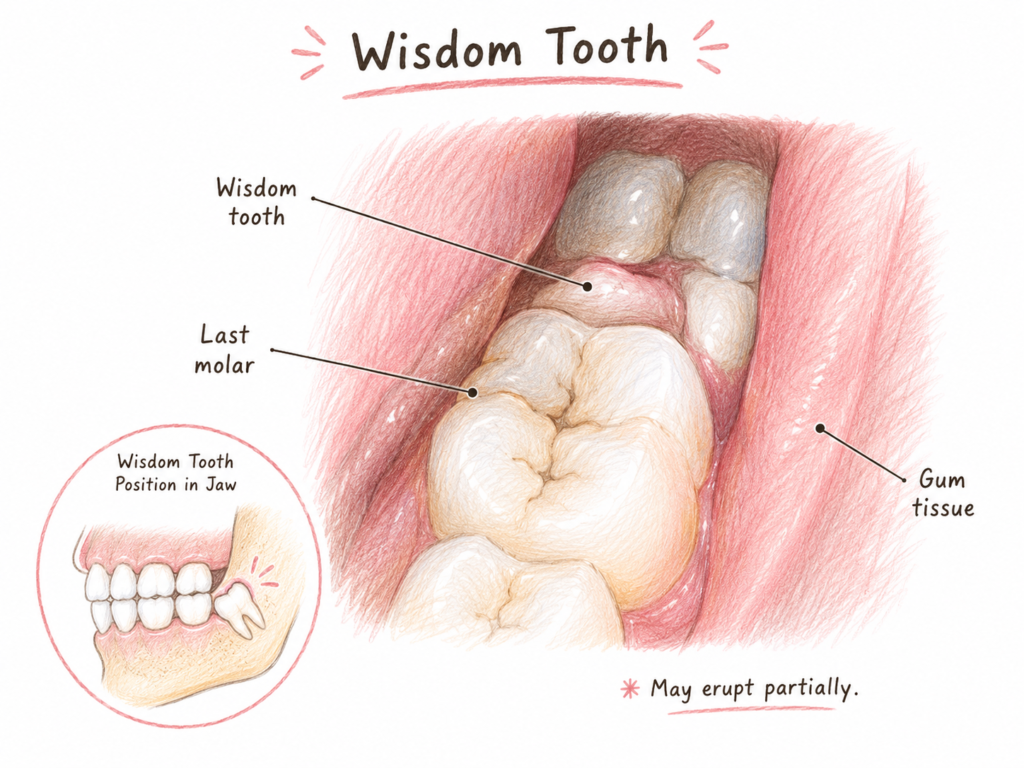
If the extra tooth is pushing into the second molar, trapping food, causing decay, or forming a cyst, removal may be advised. If it is deep in bone and not causing trouble, the dentist may monitor it with X-rays.
| Extra tooth factor | Possible plan |
|---|---|
| No pain and low risk | Monitor |
| Pushing nearby tooth | Consider removal |
| Causing infection | Treat and likely remove |
| Near nerve or sinus | Careful planning |
| Deep in bone | Specialist opinion may help |
| Linked with cyst | Treatment needed |
Questions before removing an extra tooth
Before surgery, it is okay to ask questions. A good dental plan should make sense to the patient.
- Is this an extra tooth or a root piece?
- Is it causing damage?
- What happens if we leave it?
- Is it close to a nerve or sinus?
- What type of X-ray do we need?
- Will I need stitches?
- What is the recovery time?
- What warning signs should I watch for?
| Decision question | Why it matters |
|---|---|
| Remove or monitor? | Avoids needless treatment |
| Simple or surgical? | Sets recovery expectations |
| Nerve risk? | Important for lower teeth |
| Sinus risk? | Important for upper teeth |
| Follow-up plan? | Keeps healing on track |
Easy Ways to Manage Wisdom Tooth Pain Before a Dental Visit
Home care can reduce irritation, but it cannot confirm the cause. If pain is strong, swelling is present, or symptoms are getting worse, a dental visit is needed.
For mild soreness, gentle cleaning and soft foods may help. Do not use sharp tools, do not cut the gum, and do not try to pull a hard piece out yourself. The back of the mouth can bleed and become infected if handled roughly.
| Home care step | Why it helps |
|---|---|
| Gentle brushing | Keeps bacteria low |
| Soft foods | Reduces pressure |
| Warm salt water when allowed | Can soothe gum |
| Avoid smoking | Supports healing |
| Avoid picking | Prevents injury |
| Call dentist | Gets the right answer |
Foods that are kinder to sore back gums
Food choices matter when the gum is tender. Soft, smooth foods are less likely to scratch the area or get stuck.
- Yogurt
- Mashed potatoes
- Scrambled eggs
- Soft rice
- Pasta
- Soup that is not too hot
- Smooth oatmeal
- Soft fish
- Banana
- Applesauce
| Better for sore gums | More likely to irritate |
|---|---|
| Soft eggs | Chips |
| Yogurt | Seeds |
| Mashed potato | Nuts |
| Soft pasta | Hard toast |
| Smooth soup | Spicy crunchy snacks |
| Banana | Popcorn |
What You Should Not Do If You Feel a Wisdom Tooth Coming Back
The worst mistake is trying to fix the area at home without knowing what it is. A hard piece may be bone. It may be tooth root. It may be an extra tooth. It may be a gum swelling over infection. Each one needs a different plan.
Trying to pull, scrape, cut, or burn the area can make the problem worse. Pain medicine may help for a short time, but it does not solve infection, decay, or trapped bone.
| Unsafe action | Why to avoid it |
|---|---|
| Pulling a hard piece | Can cause bleeding or infection |
| Cutting gum | Can injure tissue |
| Using sharp tools | Can damage nearby teeth |
| Ignoring swelling | Infection can worsen |
| Taking old antibiotics | May be wrong or unsafe |
| Waiting with fever | Needs urgent care |
Safer choices
Safer steps are simple and practical. They help you stay calm until a dentist checks the area.
Choose these instead:
- Take a clear photo if you can
- Write down your symptoms
- Keep the area clean
- Avoid chewing hard food on that side
- Use pain relief only as directed on the label or by a clinician
- Call your dentist for advice
- Ask whether you need an urgent visit
| Concern | Safer response |
|---|---|
| Sharp spot | Dental check |
| Bad taste | Cleaning advice and exam |
| Swelling | Urgent dental advice |
| Pain with biting | Check second molar |
| Tooth-like bump | X-ray |
| Numbness | Dental or surgical review |
How Dentists Usually Explain the Difference
Dentists often separate this issue into a few simple groups. The first group is normal healing. The second is healing trouble, such as dry socket or infection. The third is leftover material, such as bone or root. The fourth is a rare extra tooth. The fifth is a different dental problem nearby.
This grouping helps because it avoids panic. It also stops the patient from thinking every hard spot is a new tooth.
| Group | Example |
|---|---|
| Normal healing | Gum ridge, mild soreness |
| Healing problem | Dry socket, infection |
| Leftover or moving tissue | Bone fragment, root piece |
| Rare tooth issue | Extra tooth |
| Nearby dental problem | Second molar decay, gum pocket |
Simple chair-side explanation
A clear dental explanation may sound like this:
- “The same wisdom tooth cannot grow again.”
- “We need to see what the hard area is.”
- “It may be bone, gum healing, root, or an extra tooth.”
- “An X-ray will answer more than guessing.”
- “If there is infection, we treat that first.”
- “If it is harmless healing bone, we may smooth or monitor it.”
| Patient worry | Calm dental reply |
|---|---|
| Did it grow back? | The same tooth cannot return |
| Why does it feel hard? | Healing bone can feel hard |
| Is it dangerous? | We need to check signs and X-ray |
| Will I need surgery again? | Only if the finding needs removal |
| Can I wait? | Depends on pain, swelling, and infection signs |
Unique Insight: The “Back Tooth Blind Spot”
Many people clean the front teeth well but miss the last molars. After wisdom tooth removal, the last standing tooth is usually the second molar. It becomes the new back tooth. The back side of this tooth is hard to reach and easy to ignore.
This creates a “back tooth blind spot.” Food, plaque, and gum swelling can build up there. Later, the patient may think the wisdom tooth area is causing pain, but the second molar is the real issue.
| Back tooth blind spot problem | Why it happens |
|---|---|
| Missed brushing | Tooth is far back |
| Food packing | Gum shape behind molar |
| Floss difficulty | Tight or awkward contact |
| Gum pocket | Hard to clean area |
| Decay on back surface | Not easy to see |
How to protect the new last tooth
Once wisdom teeth are removed, the second molars deserve extra care. This is a small habit change that can prevent many future problems.
Helpful habits include:
- Angle the toothbrush behind the last molar
- Use a small brush head if your mouth is tight
- Ask your dentist if the gum pocket is healing well
- Use floss carefully near the last molar
- Do not skip dental cleanings
- Mention any bad taste from the back gum
- Ask the hygienist to show the exact cleaning angle
| Habit | Benefit |
|---|---|
| Brushing behind last molar | Less plaque |
| Flossing carefully | Less food trapping |
| Dental cleaning | Finds hidden buildup |
| Gum check | Spots pockets early |
| X-ray when needed | Finds back-surface decay |
Example Cases That Make This Easier to Understand
Real-life style examples can make the topic clearer. These examples are not a diagnosis. They show how different causes can feel similar.
A person may feel a sharp piece after two weeks and think it is a tooth. It may be a bone fragment. Another person may feel pain after two years. It may be decay on the second molar. A third person may have an X-ray and learn that an extra tooth is present.
| Example | What it sounds like | Likely check |
|---|---|---|
| Sharp spot after surgery | “Something white is poking out” | Exam for bone fragment |
| Pain after years | “My wisdom tooth came back” | X-ray of second molar area |
| Swelling and bad taste | “The gum is infected” | Infection check |
| Tooth shape on X-ray | “There is another tooth” | Extra tooth assessment |
| Root left on purpose | “Part of it is still there” | Review surgery notes |
Case style notes
These examples show why guessing is hard.
Common patterns include:
- Sharp does not always mean tooth
- Pain does not always mean wisdom tooth
- A lump does not always mean a dangerous problem
- A healed socket can still have nearby issues
- X-rays often give the clearest answer
- The second molar should not be ignored
| Pattern | Takeaway |
|---|---|
| Same feeling, different cause | Dental check matters |
| Same area, different source | Nearby teeth can refer pain |
| Same worry, different treatment | Do not self-treat |
| Same symptom, different timing | Healing stage matters |
Should All Wisdom Teeth Be Removed?
Not every wisdom tooth needs removal. Some come through straight, have enough space, and can be cleaned well. These may stay in place with routine monitoring. Removal is usually considered when there is pain, infection, decay, gum disease, cyst risk, damage to nearby teeth, or other clear problems.
This matters because some people worry after removal and think they should have kept the tooth. Others worry before removal and think every wisdom tooth must come out. The better answer is personal. The dentist should look at the tooth position, symptoms, risks, and cleaning ability.
| Wisdom tooth condition | Common plan |
|---|---|
| Healthy and easy to clean | Monitor |
| Partly covered by gum | Watch or treat if problems occur |
| Repeated gum infection | Removal may be advised |
| Decay that cannot be fixed | Removal may be advised |
| Damaging nearby tooth | Removal may be advised |
| Deep and symptom-free | Monitor or specialist advice |
How this connects to “growing back”
When a wisdom tooth is removed for a good reason, the same tooth will not return. But if not all wisdom tooth areas were treated, another wisdom tooth may still come in from a different corner of the mouth. That can feel like one “came back,” but it may simply be a different wisdom tooth.
Check these points:
- Were all four wisdom teeth removed?
- Were only the painful ones removed?
- Did you have fewer or more than four?
- Were any teeth still developing?
- Did the dentist mention extra teeth?
- Do you have copies of your X-rays?
| Question | Why it matters |
|---|---|
| How many were removed? | Avoids confusion |
| Which side hurts now? | Matches symptoms to treatment |
| Were there extra teeth? | Explains rare later tooth |
| Were roots left? | Explains later hard areas |
| Was follow-up done? | Confirms healing |
Recovery Expectations After Wisdom Tooth Removal
Recovery is different for each person. A simple removal may heal faster. A deeply impacted tooth may cause more swelling and soreness. Stitches, bone removal, tooth sectioning, and longer surgery can all affect healing.
The gum may feel better before the bone is fully settled. This is one reason people may feel changes weeks or months later. The surface may look closed, while deeper bone is still reshaping.
| Recovery feature | What may happen |
|---|---|
| Pain | Often improves with time |
| Swelling | Usually peaks early, then reduces |
| Jaw stiffness | Can last longer after harder surgery |
| Gum closing | Happens gradually |
| Bone reshaping | Can take more time |
| Odd feelings | May happen during healing |
Signs healing is moving in the right direction
Healing is usually not perfect every day, but the overall trend should improve.
Good signs include:
- Less swelling
- Less pain
- Better mouth opening
- No fever
- No bad taste
- Less bleeding
- Easier chewing
- Gum looks calmer
- No new spreading redness
| Improving sign | Meaning |
|---|---|
| Pain is lower | Healing is likely moving well |
| Swelling is smaller | Inflammation is settling |
| Gum is pinker | Tissue is calming |
| No bad smell | Lower infection concern |
| Eating is easier | Function is returning |
How Gum Problems Can Feel Like Wisdom Tooth Pain?
Gum disease around the second molar or back gum can feel like wisdom tooth pain. This can happen after wisdom tooth removal because the back molar becomes harder to clean on its far side. If a gum pocket forms, bacteria can collect and cause soreness, bleeding, bad breath, and pressure.
Gum disease pain may not be sharp at first. It may feel like dull pressure or tenderness. It may bleed when brushing. Some people only notice a bad taste.
| Gum issue | Common sign |
|---|---|
| Gum pocket | Food and bacteria collect |
| Gingivitis | Redness and bleeding |
| Periodontal disease | Deeper gum and bone support problem |
| Pericoronitis | Gum infection around a partly erupted tooth |
| Food packing | Soreness behind last tooth |
Gum care tips
Good gum care is simple but must be consistent. The back molar area needs careful attention.
Helpful steps include:
- Brush along the gumline gently
- Clean behind the last molar
- Do not scrub hard
- Ask for gum pocket measurements
- Keep dental cleaning visits
- Report bleeding that keeps happening
- Ask if a deep cleaning is needed
| Gum care habit | Why it helps |
|---|---|
| Gentle gumline brushing | Removes soft plaque |
| Flossing | Cleans between teeth |
| Professional cleaning | Removes hardened buildup |
| Gum checks | Tracks pocket depth |
| Early treatment | Prevents bigger problems |
What Happens If a Wisdom Tooth Is Not Fully Removed?
In most cases, dentists and oral surgeons use X-rays before removing wisdom teeth, so missed wisdom teeth are unlikely. Still, confusion can happen if a person had only some wisdom teeth removed, if an extra tooth was hidden, or if the patient does not remember which teeth were removed.
A tooth can also be removed in pieces. If the patient later sees a small hard piece, they may think a tooth was missed. It may be bone or a tiny tooth fragment. The only way to know is with an exam and imaging.
| Situation | Is it possible? |
|---|---|
| Same full tooth missed after full removal | Unlikely |
| Another wisdom tooth on different side remains | Possible |
| Extra tooth hidden | Possible |
| Small root fragment remains | Possible |
| Bone fragment appears | Possible |
How to avoid confusion before surgery
Before wisdom tooth removal, ask your dentist to explain the plan clearly. This can prevent fear later.
Good questions include:
- How many wisdom teeth do I have?
- Which ones are being removed?
- Are any being left in place?
- Are any close to a nerve or sinus?
- Will the tooth be removed in pieces?
- Could roots be left for safety?
- What should I expect during healing?
| Before-surgery question | Helps you understand |
|---|---|
| Tooth count | How many exist |
| Removal plan | Which teeth are treated |
| Risk areas | Nerve or sinus concerns |
| Healing plan | What is normal after |
| Follow-up | When to return |
What Your Symptom May Mean
This table can help you sort your thoughts before a dental visit. It is not a diagnosis, but it helps you explain the problem better.
| Your symptom | Possible cause | What to do |
|---|---|---|
| Hard sharp piece soon after removal | Bone fragment | Call dentist |
| Strong pain after a few days | Dry socket | Dental treatment needed |
| Bad taste and swelling | Infection or food trapping | Dental check |
| Pain years later | Second molar or gum problem | Exam and X-ray |
| Tooth shape seen under gum | Extra tooth or retained root | Imaging and treatment plan |
| Cold sensitivity | Decay or root exposure | Check second molar |
| Jaw stiffness | Surgery soreness or jaw strain | Follow advice, call if severe |
| Numb lip or chin | Nerve irritation | Contact dentist or surgeon |
| Upper pressure near cheek | Sinus or upper tooth issue | Dental or medical check |
Best next step by symptom type
Use the symptom pattern to choose the right next step.
Helpful choices include:
- Mild and improving: follow aftercare
- Sharp and annoying: book a non-emergency check
- Pain getting worse: call soon
- Swelling and fever: urgent dental help
- Trouble swallowing: emergency help
- Years-later pain: routine exam with X-ray
- Tooth-like lump: imaging check
| Symptom level | Best response |
|---|---|
| Mild | Monitor and clean gently |
| Moderate | Book dental visit |
| Worsening | Call quickly |
| Severe with swelling | Urgent care |
| Breathing or swallowing trouble | Emergency care |
Commonly Asked Question
This section answers common questions in plain language. The goal is to remove fear and make the next step clear.
| Question type | Main idea |
|---|---|
| Growth | Same tooth cannot return |
| Hard spot | May be bone or root |
| Pain | May come from many causes |
| Extra tooth | Rare but possible |
| Treatment | Depends on exam and X-ray |
Can the same wisdom tooth grow back after removal?
No. If the tooth and roots were fully removed, the same wisdom tooth cannot grow back.
- Adult teeth do not regrow naturally
- Wisdom teeth are adult molars
- A fully removed tooth is gone
- A new feeling does not always mean a new tooth
- An X-ray can confirm what is present
| Claim | Truth |
|---|---|
| Same tooth returns | No |
| Extra tooth appears | Rarely possible |
| Bone feels like tooth | Yes |
| Root piece may remain | Sometimes |
| X-ray helps | Yes |
Why do I feel something hard where my wisdom tooth was removed?
A hard feeling may be bone, scar tissue, a root piece, or rarely an extra tooth. It may also be the shape of the healing jawbone.
- Bone edge
- Bone fragment
- Tooth root piece
- Extra tooth
- Healing ridge
- Gum scar over bone
| Hard feeling | Needs check when |
|---|---|
| Small and improving | Usually not urgent |
| Sharp and painful | Dentist should see it |
| Comes with swelling | Possible infection |
| Gets larger | Needs exam |
| Lasts long | X-ray may help |
Can an extra wisdom tooth come in after removal?
Yes, but this is uncommon. It is not the removed tooth growing back. It is an extra tooth that may have formed in addition to the usual wisdom teeth.
Signs that need a check include:
- Tooth-like lump
- Pressure behind the last molar
- Pain years after removal
- X-ray showing a tooth shape
- Gum swelling over a hard structure
| Extra tooth question | Answer |
|---|---|
| Is it common? | No |
| Is it the same tooth? | No |
| Can it hurt? | Yes, if it causes pressure or infection |
| Can it stay? | Sometimes, if low risk |
| Can it need removal? | Yes, if causing problems |
Can a root left behind grow into a new tooth?
No. A root cannot grow a new crown like a new tooth. A root piece may move, become exposed, or cause irritation, but it is not a new wisdom tooth.
- A retained root is part of the old tooth
- It may be left for safety in some cases
- It may never cause trouble
- It may need removal if infected
- X-rays help monitor it
| Root issue | Meaning |
|---|---|
| Root left | Old tooth part remains |
| Root moves | May shift during healing |
| Root exposed | Can irritate gum |
| Root infected | Needs dental treatment |
| Root grows new tooth | No |
Should I worry about pain months after removal?
You should not panic, but you should not ignore it if it continues. Months-later pain may come from the second molar, gum pocket, bone fragment, retained root, or another issue.
- Pain that keeps returning
- Swelling
- Bad taste
- Bleeding
- Pain on biting
- Cold sensitivity
- Hard lump
| Pain timing | What to consider |
|---|---|
| Days after removal | Healing or dry socket |
| Weeks after removal | Bone or gum healing |
| Months after removal | Bone remodeling or nearby tooth issue |
| Years after removal | New dental problem or rare extra tooth |
Final Thoughts
Wisdom teeth do not grow back after full removal. If you feel something hard, sharp, sore, or swollen in the same area, there is usually another reason. It may be healing bone, a bone fragment, food trapping, gum swelling, a second molar problem, a retained root, or rarely an extra tooth.
The safest answer comes from a dental exam and, when needed, an X-ray. Do not try to pull or cut anything at home. Do not ignore swelling, bad taste, fever, or pain that gets worse. A quick check can turn a scary guess into a clear plan.
| Key takeaway | Simple meaning |
|---|---|
| Same wisdom tooth cannot regrow | Full removal is permanent |
| Extra teeth can happen | Rare, but possible |
| Bone can feel like tooth | Common after healing |
| Pain may come from nearby teeth | Check the second molar |
| X-rays give clear answers | Guessing is not enough |
| Worsening symptoms need care | Infection should not wait |
Short closing checklist
- Were all wisdom teeth removed?
- Is the pain new or from healing?
- Is there swelling or bad taste?
- Is the hard spot sharp or tooth-shaped?
- Does the second molar hurt with cold or biting?
- Do I need an X-ray?
- Should I call the dentist who removed it?
| If you remember one thing | Remember this |
|---|---|
| Fully removed wisdom teeth do not grow back | But other problems can feel similar |
| A hard spot is not always a tooth | It may be bone |
| Pain years later is often nearby | Second molar and gum should be checked |
| Dental imaging helps | It shows what touch cannot |