


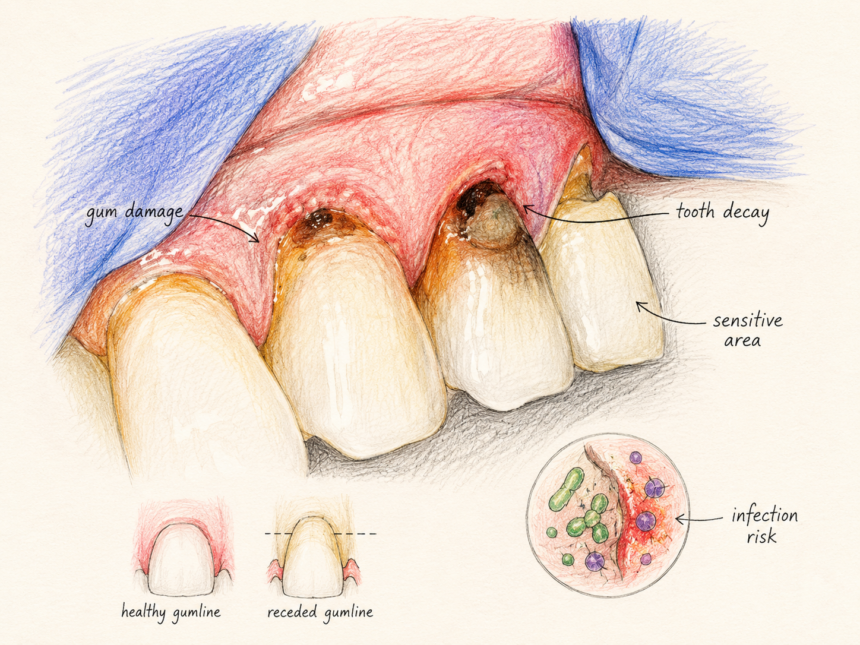
Gum line cavities can be confusing because they often start in a place that is easy to miss. A person may brush the front of the tooth and still miss the tiny area where the tooth meets the gum. This area can collect plaque, food, and bacteria. Over time, acid from bacteria can weaken the tooth surface and create a cavity near the gum.
A gum line cavity may look like a small brown spot, a dark line, a soft area, or a notch near the gum. Sometimes there is no pain at first. This is why many people do not notice it until the cavity becomes deeper. When the cavity grows, it can cause sensitivity, pain, gum soreness, or a rough feeling near the tooth.
canal
| Main point | Simple meaning |
|---|---|
| Gum line cavity | Tooth decay close to the gum |
| Common cause | Plaque staying near the gum edge |
| Early sign | White, brown, or dark spot near the gum |
| Common feeling | Sensitivity to cold, sweet, or brushing |
| Main treatment | Fluoride, filling, crown, or root canal depending on depth |
| Best prevention | Clean the gum line daily and see a dentist regularly |
What Is a Gum Line Cavity?
A gum line cavity is tooth decay that forms near the place where the tooth and gum meet. This area is called the gum line. It is a narrow border, and plaque can sit there if brushing is rushed or if the toothbrush does not reach the area well.
A gum line cavity can happen on the crown of the tooth, which is the part covered by enamel. It can also happen on the root surface if the gum has pulled back. Root surface cavities can grow faster because the root is not protected by strong enamel like the crown of the tooth.
Dental care note: A cavity near the gum is not always large when it first starts. A tiny spot can be the early stage of damage, so it is better to get it checked before it becomes painful.
| Type of gum line decay | Where it happens | Why it matters |
|---|---|---|
| Enamel gum line cavity | Near the gum on the crown | May start as a small spot |
| Root cavity | On exposed tooth root | Can grow faster |
| Between teeth near gum | Near the contact point and gum | Often hard to see |
| Around old filling | At the edge of dental work | May need repair |
| Under gum edge | Slightly below gum line | Often needs dental tools to find |
Why This Area Is Easy to Miss
The gum line is easy to miss because many people brush the flat front surfaces of the teeth but do not angle the brush toward the gum edge. Plaque then stays in a thin line along the gum. This plaque may not look serious at first, but it can keep making acid after meals and snacks.
The gum line is also sensitive. Some people avoid brushing it because it bleeds or feels sore. This makes the problem worse because plaque stays longer. Bleeding gums often mean the area needs gentler but better cleaning, not less cleaning.
Common reasons people miss the gum line include:
- Brushing too fast
- Using a hard toothbrush
- Scrubbing the middle of the tooth but not the gum edge
- Avoiding sore or bleeding gums
- Not flossing near the gum
- Having crowded teeth
- Having braces, retainers, or old dental work
- Dry mouth making plaque stickier
| Brushing habit | Possible result |
|---|---|
| Brush stays flat on tooth | Gum edge is missed |
| Brush is too hard | Gum may pull back |
| Brushing is rushed | Plaque stays near gum |
| Floss does not reach gum curve | Decay can start between teeth |
| Painful gums are avoided | Plaque builds up more |
Main Causes of Gum Line Cavities
Gum line cavities form when bacteria, sugar, acid, and weak tooth surfaces work together. Bacteria live in plaque. When a person eats or drinks sugar or starch often, bacteria make acid. This acid attacks the tooth surface. If the acid attack happens again and again, the tooth loses minerals and a cavity can form.
The gum line is at higher risk because plaque often sits there for long periods. If the gum has pulled back, the root can become exposed. Root surfaces are softer than enamel, so decay may move faster there.
Dental care note: A gum line cavity is rarely caused by one single meal or one missed brushing. It usually forms from repeated small habits over time.
| Cause | How it affects the gum line |
|---|---|
| Plaque buildup | Holds bacteria close to the tooth |
| Frequent sugar | Feeds acid-making bacteria |
| Dry mouth | Reduces natural cleaning from saliva |
| Gum recession | Exposes softer root surface |
| Poor brushing angle | Leaves plaque along gum edge |
| Old fillings | Edges can trap bacteria |
| Crowded teeth | Harder to clean near gum |
| Acidic drinks | Can weaken tooth surface |
The Plaque Line Problem
The plaque line is the sticky film that often sits right where the gum meets the tooth. It may look like a soft yellow or white layer. Sometimes it is hard to see, but the tongue may feel a fuzzy area. If plaque is not removed, it can harden into tartar. Tartar cannot be removed well with a normal toothbrush at home.
Once tartar forms near the gum, it creates a rough surface where more plaque can stick. This makes the gum line cavity risk higher.
Signs of plaque line buildup include:
- Fuzzy feeling near the gum
- Yellow film at the tooth edge
- Bad breath that returns quickly
- Bleeding when brushing
- Gum swelling
- Tooth surface feels rough
- Stains near the gum
| Plaque stage | What it means |
|---|---|
| Soft plaque | Can usually be brushed away |
| Thick plaque | Needs better brushing and flossing |
| Tartar | Needs professional cleaning |
| Plaque near old filling | May cause decay around the edge |
| Plaque under gum edge | Can also harm gum health |
Sugar Frequency Matters More Than People Think
Many people think cavities only happen when someone eats a lot of candy. Candy can be a problem, but the number of times sugar touches the teeth also matters. Sipping sweet tea all day may be worse than eating a sweet item once with a meal.
Each sugar exposure gives mouth bacteria a chance to make acid. If this happens many times a day, the tooth has less time to recover.
Common sugar habits that raise risk include:
- Sipping soda slowly
- Drinking sweet coffee many times a day
- Eating biscuits or cookies between meals
- Using sugary chewing sweets often
- Drinking sports drinks
- Taking sweetened medicine often
- Eating sticky snacks that stay near the gum
| Habit | Why it can raise cavity risk |
|---|---|
| Sweet drink between meals | Repeated acid attacks |
| Sticky sweets | Sugar stays longer |
| Sweet coffee all day | Teeth get less recovery time |
| Bedtime snack after brushing | Sugar stays overnight |
| Frequent small snacks | More acid periods |
Gum Recession and Root Cavities
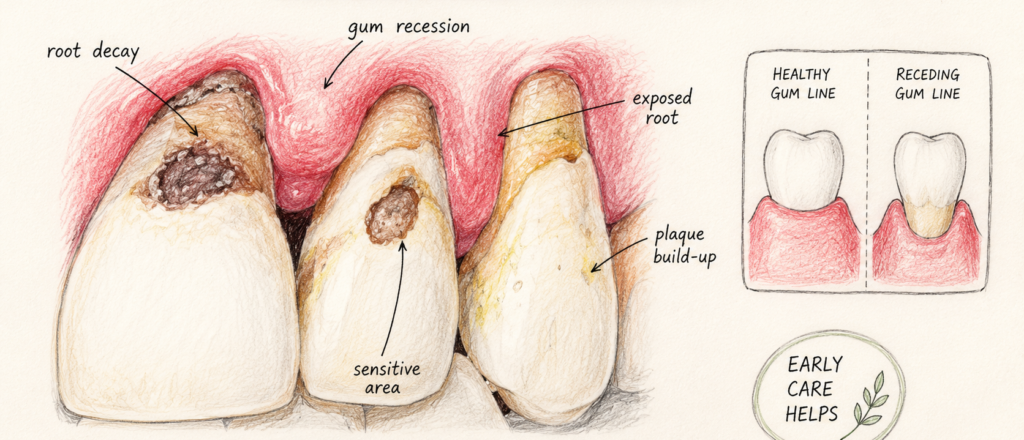
Gum recession means the gum moves away from the tooth and exposes more of the tooth surface. When the root is exposed, cavities can form more easily. The root surface does not have the same strong enamel covering as the upper part of the tooth. This makes root cavities a serious concern, especially for adults.
Gum recession can happen slowly. A person may notice the tooth looks longer, the gum line looks uneven, or cold drinks feel sharp near the gum. Root cavities often start close to the gum and may spread around the tooth if untreated.
Dental care note: A root cavity can be softer and faster moving than a normal enamel cavity. This is why exposed roots need special care.
| Gum recession sign | What it may mean |
|---|---|
| Tooth looks longer | Gum has moved down |
| Yellow area near gum | Root surface may be exposed |
| Cold sensitivity | Root may be uncovered |
| Notch near gum | Wear or decay may be present |
| Gum line looks uneven | Recession may be active |
| Food sticks near gum | Shape has changed |
Why Gums Pull Back
Gums can pull back for many reasons. Some are linked to cleaning habits. Some are linked to gum disease, age, genetics, or tooth position. Brushing too hard can damage the gum over time. Not brushing well can also harm gums because plaque causes swelling and gum disease.
This can feel unfair because both rough brushing and poor brushing can cause problems. The right method is gentle but complete cleaning.
Common reasons for gum recession include:
- Brushing too hard
- Using a hard toothbrush
- Gum disease
- Teeth grinding
- Crooked teeth
- Tobacco use
- Piercings rubbing the gum
- Poorly fitting dental work
- Age-related gum changes
- Family tendency
| Cause | What happens |
|---|---|
| Hard brushing | Gum edge wears down |
| Gum disease | Gum support weakens |
| Grinding | Pressure can affect tooth and gum |
| Crowding | Some areas are harder to clean |
| Tobacco | Gum healing becomes weaker |
| Old dental work | Edges may irritate gum |
Signs of a Gum Line Cavity
A gum line cavity may not hurt at first. This is one reason regular dental checks matter. Early decay can look like a chalky white spot, light brown mark, dark line, or small soft area near the gum. Some people notice sensitivity before they see anything.
As the cavity grows, symptoms may become clearer. The tooth may hurt with cold water, sweet food, brushing, or chewing. The gum near the tooth may also feel tender because plaque and decay can irritate the area.
Dental care note: Pain is not the best first warning sign. A cavity can be present before pain starts.
| Sign | What it may mean |
|---|---|
| White spot near gum | Early mineral loss |
| Brown or black mark | Possible decay or stain |
| Sensitivity to cold | Root or dentin may be exposed |
| Pain with sweets | Decay may be active |
| Rough edge | Tooth surface may be damaged |
| Food sticking | Cavity or gap may be present |
| Gum bleeding | Plaque or gum irritation |
Early Signs You May Notice at Home
Home signs can help you decide when to book a dental visit. They cannot confirm a cavity, but they can warn you that something needs checking.
Early signs may include:
- A new spot near the gum
- Tooth feels rough near the gum
- Cold water causes a short sharp feeling
- Brushing one area feels sore
- Floss catches or tears near the gum
- Food sticks at the same place
- Gum bleeds near one tooth
- Bad taste from one area
| Home sign | Best next step |
|---|---|
| New spot | Book a dental check |
| Short sensitivity | Use gentle care and ask dentist |
| Floss catches | Check for decay or rough filling |
| Gum bleeding | Improve cleaning and get gum check |
| Food keeps sticking | Dentist should inspect the area |
Late Signs That Need Faster Care
Late signs mean the cavity may be deeper. Waiting too long can lead to bigger treatment. If pain becomes strong or swelling starts, the tooth may be infected.
Late signs include:
- Pain that lasts after cold or hot drinks
- Pain when biting
- Swelling near the gum
- Pus or bad taste
- A visible hole
- Tooth feels loose
- Pain wakes you at night
- Face swelling
- Fever with dental pain
| Late sign | Why it matters |
|---|---|
| Long-lasting pain | Nerve may be irritated |
| Swelling | Infection may be present |
| Visible hole | Decay has broken tooth surface |
| Bad taste | Possible drainage |
| Pain at night | Deeper tooth problem |
| Loose tooth | Gum or bone support may be affected |
How Dentists Check Gum Line Cavities
A dentist checks gum line cavities with a visual exam, dental tools, X-rays, and sometimes gum measurements. The dentist may gently feel the tooth surface to check if it is soft, sticky, rough, or broken. They may also check around old fillings and between teeth.
X-rays can help show decay between teeth or below the visible surface. However, not every gum line cavity is easy to see on an X-ray, especially if it is on the front or outer surface. This is why both the exam and the X-ray matter.
Dental care note: A small gum line cavity can hide in plain sight. Good lighting, dry tooth surfaces, and a careful exam can make a big difference.
| Dental check | What it helps find |
|---|---|
| Visual exam | Spots, holes, stains, gum changes |
| Dental explorer | Soft or rough tooth surface |
| X-ray | Decay between teeth or deeper areas |
| Gum measurement | Gum pockets and recession |
| Bite check | Pain from pressure or cracks |
| Filling edge check | Decay around old dental work |
Why X-Rays Are Helpful
X-rays help the dentist see areas that are not easy to view with the eyes. A gum line cavity between teeth may not be visible until it becomes large. An X-ray can show hidden decay earlier.
X-rays can also show how close decay is to the nerve, whether bone support has changed, and whether old fillings have gaps.
X-rays may help show:
- Decay between teeth
- Decay under old fillings
- Deep cavities close to the nerve
- Bone loss from gum disease
- Root shape
- Infection near the root
- Problems under crowns
| X-ray finding | Possible meaning |
|---|---|
| Dark area near tooth edge | Decay may be present |
| Gap near filling | Filling may be leaking |
| Deep dark area | Decay may be close to nerve |
| Bone loss | Gum disease may be involved |
| Root infection | More treatment may be needed |
Treatment Options for Gum Line Cavity Causes Signs
Treatment depends on the stage of the cavity. Early mineral loss may be treated with fluoride and better cleaning. A small cavity may need a filling. If the cavity is large or close to the nerve, the tooth may need a crown or root canal. If the tooth is badly damaged, removal may be discussed, but dentists usually try to save the tooth when possible.
Gum line cavities can be harder to treat than some other cavities because they are close to the gum. The area may be moist, sensitive, or hard to isolate. This is why early care is helpful.
Dental care note: The earlier the cavity is treated, the more tooth structure can usually be saved.
| Stage | Common treatment |
|---|---|
| Early white spot | Fluoride and daily care |
| Small surface cavity | Filling |
| Root cavity | Filling or special root treatment |
| Cavity near old filling | Replace or repair filling |
| Large cavity | Crown may be needed |
| Cavity reaches nerve | Root canal may be needed |
| Tooth cannot be saved | Extraction may be discussed |
Fluoride Treatment for Early Gum Line Decay
If the tooth surface is weak but not broken, fluoride may help stop or reverse early mineral loss. Fluoride helps strengthen the tooth and supports repair from minerals in saliva. This works best before a full hole forms.
A dentist may use fluoride varnish, gel, or prescription toothpaste. Home care is also important because fluoride cannot help much if plaque and sugar exposure continue.
Fluoride support may include:
- Fluoride toothpaste
- Fluoride varnish at the dental office
- Prescription fluoride toothpaste
- Fluoride mouth rinse if advised
- Better brushing near the gum
- Less frequent sugar
- More water during the day
| Fluoride option | Who may benefit |
|---|---|
| Regular fluoride toothpaste | Most people |
| Fluoride varnish | Higher cavity risk |
| Prescription toothpaste | Root cavities or repeated decay |
| Fluoride rinse | Some patients with extra risk |
| Professional review | Needed to track progress |
Fillings for Gum Line Cavities
When a hole has formed, a filling is often needed. The dentist removes the decayed part of the tooth and fills the area with a dental material. Tooth-colored filling material is common for visible gum line areas.
Gum line fillings need careful placement. The dentist must keep the area clean and dry enough for the filling to bond. If the cavity is partly below the gum, the dentist may need to gently move the gum aside during treatment.
Filling treatment may involve:
- Numbing the tooth if needed
- Cleaning away decay
- Preparing the tooth surface
- Placing filling material
- Shaping the filling near the gum
- Polishing the edge
- Checking that it feels smooth
| Filling concern | Why it matters |
|---|---|
| Moisture near gum | Can affect bonding |
| Gum bleeding | Makes placement harder |
| Root surface | Needs careful material choice |
| Bite pressure | Filling must be shaped well |
| Rough edge | Can collect plaque |
Crowns and Root Canals for Deeper Cavities
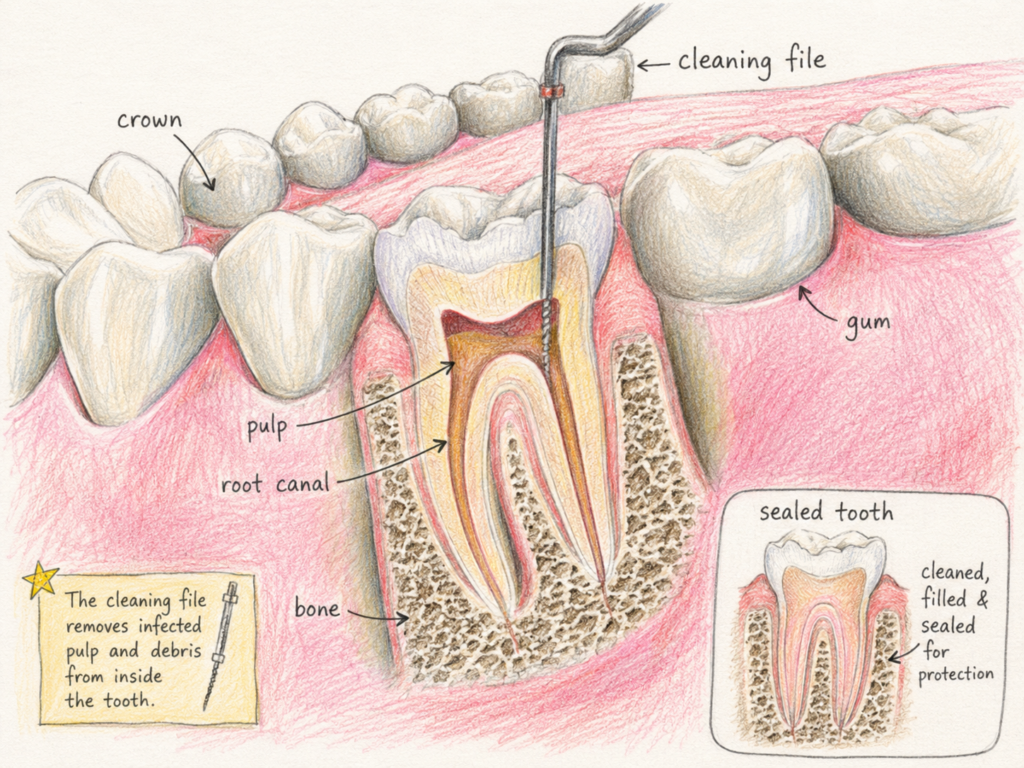
If a gum line cavity becomes large, a simple filling may not be enough. A crown may be needed when a lot of tooth structure is lost. A root canal may be needed if decay reaches the nerve inside the tooth or causes infection.
A root canal removes infected or damaged tissue from inside the tooth. After that, the tooth is sealed and often protected with a crown. This can help save a tooth that might otherwise be lost.
Deep cavity treatment may include:
- Larger filling
- Crown
- Root canal
- Crown after root canal
- Gum treatment if gum disease is present
- Extraction if the tooth cannot be saved
| Deep cavity issue | Possible treatment |
|---|---|
| Large missing tooth area | Crown |
| Pain that lingers | Nerve check |
| Infection | Root canal or extraction |
| Weak tooth | Crown for support |
| Decay below gum | Special planning needed |
Gum Line Cavities Around Old Fillings
Cavities can form around old fillings. This is called recurrent decay. It happens when bacteria enter a small gap between the filling and tooth. The gap may form because the filling is worn, cracked, loose, or no longer sealed well.
Near the gum line, this problem can be easy to miss. A person may see a dark edge and think it is only stain. Sometimes it is stain, but sometimes it is decay under the edge of the filling.
Dental care note: A dark line around a filling does not always mean decay, but it should be checked because hidden decay can grow under dental work.
| Old filling issue | What it can lead to |
|---|---|
| Cracked filling | Bacteria can enter |
| Open edge | Food and plaque collect |
| Rough filling surface | Harder to clean |
| Worn filling | Tooth may weaken |
| Dark edge | Stain or decay |
| Loose filling | Higher risk of new cavity |
Signs an Old Filling May Need Repair
A filling can last many years, but it does not last forever. If the edge breaks down, a gum line cavity can start around it.
Signs to watch include:
- Food catches near the filling
- Floss tears near the edge
- Tooth feels rough
- Filling looks chipped
- Dark line grows
- Sensitivity returns
- Pain when biting
- Bad taste near one tooth
| Sign | Possible reason |
|---|---|
| Floss shredding | Rough or open edge |
| Food trapping | Gap or broken filling |
| New sensitivity | Decay or weak seal |
| Dark line | Stain or decay |
| Pain on biting | Filling or tooth crack |
Gum Line Cavity or Tooth Sensitivity
Not every sensitive gum line area is a cavity. Sensitivity can happen from gum recession, enamel wear, tooth grinding, acidic drinks, whitening products, or brushing too hard. Still, sensitivity should not be ignored because a cavity can also cause it.
The difference is not always clear at home. A dentist can check the tooth surface, gum line, and X-ray to find the cause.
Dental care note: Sensitivity is a symptom, not a diagnosis. The cause must be checked before choosing the right treatment.
| Symptom | Possible cause |
|---|---|
| Sharp cold pain that stops fast | Exposed root or early decay |
| Sweet sensitivity | Possible cavity |
| Pain with brushing | Gum recession or cavity |
| Pain when biting | Crack, cavity, or filling issue |
| Dull ache | Deeper decay or gum problem |
| Sensitivity on many teeth | Acid wear, whitening, or gum recession |
How to Tell the Difference at Home
You cannot fully diagnose a cavity at home, but you can notice patterns. These patterns help your dentist.
Helpful questions include:
- Does cold pain stop quickly or linger?
- Does sweet food cause pain?
- Is there a visible spot?
- Does the area feel rough?
- Does floss catch?
- Is the gum bleeding?
- Is only one tooth affected?
- Did whitening products make it worse?
| Pattern | More likely concern |
|---|---|
| One tooth with dark spot | Cavity needs checking |
| Many teeth sensitive | Gum recession or enamel wear |
| Pain with sweets | Cavity possible |
| Pain only while brushing | Gum or root sensitivity |
| Lingering pain | Deeper tooth issue |
Risk Factors That Make Gum Line Cavities More Likely
Some people are more likely to get gum line cavities than others. This does not mean they are careless. Risk can come from dry mouth, medicine, gum recession, braces, diet, old dental work, or health conditions. The key is to know your risk and adjust your care.
People with dry mouth are at higher risk because saliva helps wash away food and acid. Saliva also helps repair early mineral loss. When the mouth is dry, plaque can become sticky and acid can stay longer.
Dental care note:
A person with high cavity risk may need extra prevention even if they brush every day.
| Risk factor | Why it raises risk |
|---|---|
| Dry mouth | Less natural washing |
| Gum recession | Root surface is exposed |
| Frequent snacking | More acid attacks |
| Sugary drinks | Feeds bacteria often |
| Braces or retainers | More plaque traps |
| Old fillings | Edges may leak |
| Crowded teeth | Harder to clean |
| Smoking or tobacco | Gum health can worsen |
Dry Mouth and Gum Line Decay
Dry mouth can come from medicines, mouth breathing, dehydration, some health conditions, or some treatments. A dry mouth may feel sticky, uncomfortable, or thirsty. It may also cause bad breath and trouble swallowing dry foods.
When saliva is low, cavities can form faster, especially near the gum and root surfaces.
Dry mouth signs include:
- Sticky mouth
- Dry tongue
- Bad breath
- Cracked lips
- Burning feeling
- Thick saliva
- More thirst at night
- Food sticking to teeth
- More cavities than before
| Dry mouth habit or cause | Helpful response |
|---|---|
| Not drinking enough water | Sip water through the day |
| Mouth breathing | Ask dentist or doctor |
| Medicine side effect | Ask clinician about options |
| Sugary lozenges | Use sugar-free options |
| Dry night mouth | Ask about dry mouth products |
Children and Gum Line Cavities
Children can also get gum line cavities. These cavities may happen when plaque stays near the gums, especially around baby teeth, braces, or teeth that are hard to brush. Young children may also get decay near the gum if they often sleep with milk, juice, or sweet drinks.
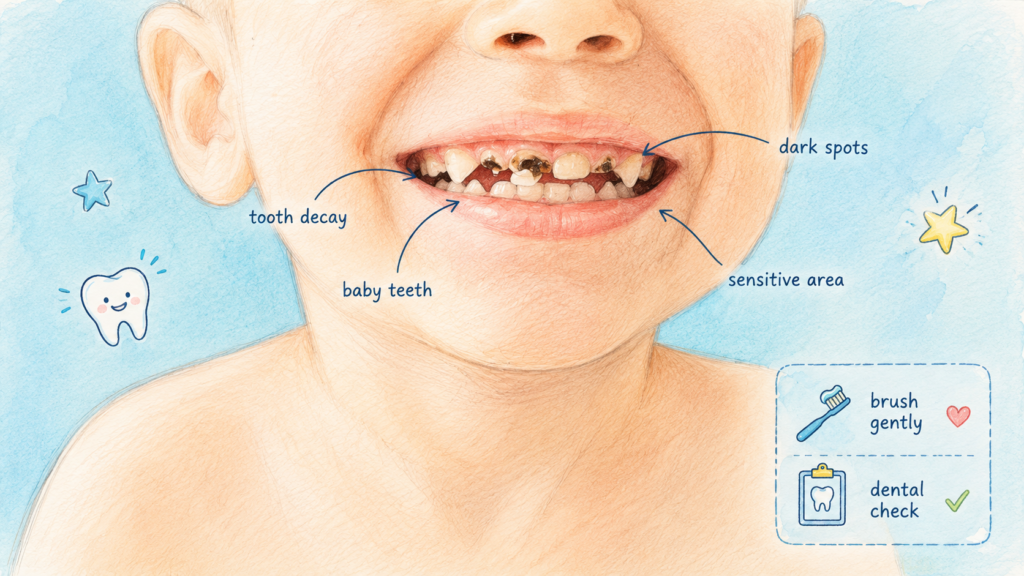
Parents should watch the gum line because children may not complain until the cavity hurts. A child may avoid chewing, cry during brushing, or say that cold drinks hurt.
Dental care note: Baby teeth matter. Cavities in baby teeth can cause pain, infection, eating trouble, and problems for future dental health.
| Child risk | Why it matters |
|---|---|
| Poor brushing skill | Plaque stays near gum |
| Sweet drinks | Repeated sugar exposure |
| Bedtime bottle | Sugar stays overnight |
| Braces | More areas to clean |
| Fear of brushing sore gums | Plaque builds up |
| Skipping dental visits | Cavities found late |
Parent Tips for Gum Line Cleaning
Children need help with brushing until they can clean well on their own. Parents should gently lift the lip and check the gum line, especially the upper front teeth and back molars.
Helpful parent tips include:
- Use the right amount of fluoride toothpaste for the child’s age
- Brush along the gum line gently
- Help with brushing before bedtime
- Avoid juice or milk in bed
- Offer water between meals
- Watch for white or brown spots
- Book dental visits early
- Ask about fluoride varnish
| Parent action | Benefit |
|---|---|
| Check gum line weekly | Spots found early |
| Help with brushing | Better plaque removal |
| Limit sweet drinks | Less acid exposure |
| Use fluoride toothpaste | Stronger tooth surface |
| Dental visits | Early treatment if needed |
Gum Line Cavities in Older Adults
Older adults often face a higher risk of root cavities because gum recession becomes more common with age. Many older adults also take medicines that can cause dry mouth. When dry mouth and exposed roots happen together, gum line cavities can form quickly.
Dental work from earlier years can also play a role. Crowns, bridges, partial dentures, and old fillings can create areas where plaque collects. Cleaning around these areas may need special tools.
Dental care note: Root cavities in older adults need early attention because they can spread around the tooth and weaken it.
| Older adult risk | Reason |
|---|---|
| Gum recession | Root becomes exposed |
| Dry mouth | Less saliva protection |
| Many medicines | Dry mouth side effect possible |
| Old fillings and crowns | Edges can collect plaque |
| Limited hand movement | Brushing may be harder |
| Dentures or partials | Food and plaque traps |
Helpful Tools for Older Adults
The right cleaning tools can make a big difference. A person with arthritis, limited grip, or many dental restorations may need more than a regular toothbrush.
Helpful tools may include:
- Electric toothbrush
- Soft toothbrush with large handle
- Fluoride toothpaste
- Interdental brushes
- Floss picks
- Water flosser if advised
- Prescription fluoride
- Dry mouth rinse
- Regular dental cleanings
| Tool | How it helps |
|---|---|
| Electric toothbrush | Easier cleaning with less effort |
| Large handle brush | Better grip |
| Interdental brush | Cleans spaces near gum |
| Fluoride toothpaste | Supports tooth strength |
| Dry mouth product | Helps comfort and moisture |
| Professional cleaning | Removes tartar |
How to Prevent Gum Line Cavities
Prevention is based on simple daily habits. The goal is to remove plaque near the gum line, reduce frequent sugar exposure, support saliva, and use fluoride. Small changes can lower risk a lot.
Prevention does not mean brushing harder. In fact, brushing too hard can damage gums. The better method is soft, careful brushing at the gum edge.
Dental care note:
The best gum line cleaning is gentle, slow, and angled toward the gum.
| Prevention step | Why it helps |
|---|---|
| Brush with fluoride toothpaste | Removes plaque and strengthens teeth |
| Clean the gum line | Targets the risky area |
| Floss daily | Cleans between teeth near gum |
| Drink water | Helps wash acids |
| Limit frequent sugar | Fewer acid attacks |
| Treat dry mouth | Protects roots |
| Dental visits | Finds early problems |
| Fluoride treatments | Helps high-risk teeth |
Better Brushing at the Gum Line
Good brushing is not about force. It is about placement. Place the toothbrush partly on the tooth and partly near the gum edge. Use gentle small movements. Take time around each tooth.
If your gums bleed, do not stop cleaning. Bleeding often improves when plaque is removed regularly. However, if bleeding continues, see a dentist.
Gum line brushing tips include:
- Use a soft toothbrush
- Angle the bristles toward the gum
- Use gentle small circles
- Do not scrub hard
- Brush the outer, inner, and chewing surfaces
- Spend extra time near the last molars
- Replace the brush when bristles spread
- Brush before sleep
| Brushing mistake | Better habit |
|---|---|
| Scrubbing hard | Use gentle circles |
| Flat brush angle | Aim toward gum edge |
| Rushing | Slow down near gum |
| Skipping inner surfaces | Brush inside teeth too |
| Old brush | Replace worn bristles |
Flossing Near the Gum Line
Flossing helps clean where the toothbrush cannot reach. The gum line between teeth is a common place for cavities because plaque hides there.
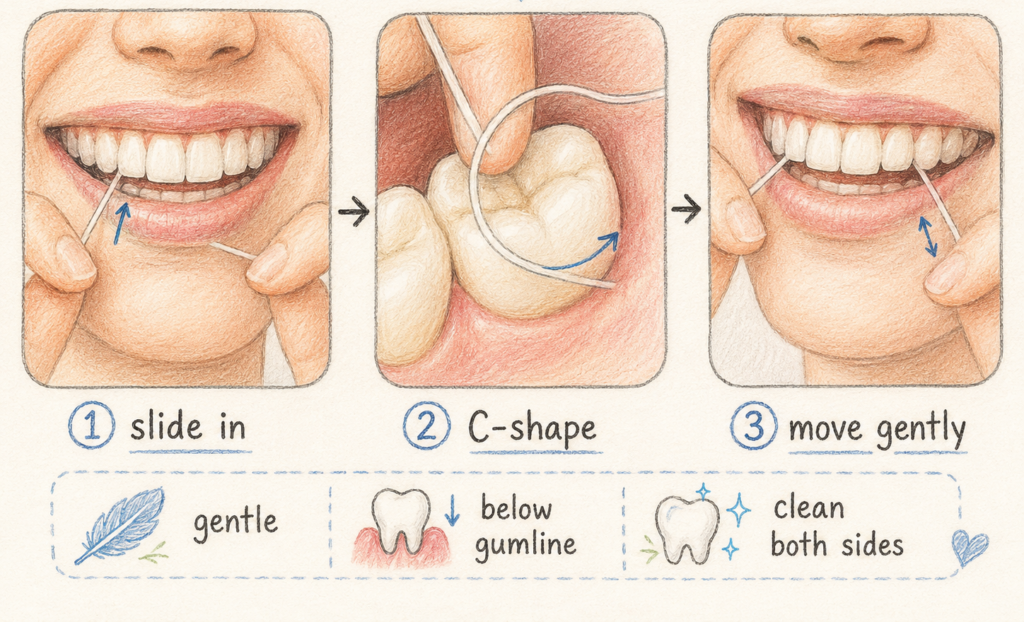
The right flossing method is gentle. Slide the floss between teeth, curve it around one tooth, and move it slightly under the gum edge without forcing it. Then do the same for the next tooth.
Flossing tips include:
- Do not snap floss into the gum
- Curve floss around the tooth
- Clean both sides of the space
- Use floss picks if normal floss is hard
- Try interdental brushes if spaces are wider
- Ask the dentist to show the best method
- Be consistent every day
| Flossing problem | Simple fix |
|---|---|
| Floss hurts | Use gentle pressure |
| Floss shreds | Check for rough filling or cavity |
| Hands feel awkward | Try floss picks |
| Wide gaps | Try interdental brush |
| Bleeding | Keep cleaning gently and get gum check |
Food and Drink Choices That Protect the Gum Line
Food choices affect cavities because bacteria use sugar and starch to make acid. Acidic drinks can also weaken the tooth surface. This does not mean you can never eat sweet food. It means timing, frequency, and cleaning matter.
A sweet item with a meal is usually less harmful than sipping sweet drinks all day. Water is the best drink for teeth between meals. Chewing sugar-free gum may help some people by increasing saliva, but it should not replace brushing.
Dental care note: The mouth needs quiet time between meals so saliva can repair early acid damage.
| Choice | Better for teeth |
|---|---|
| Water between meals | Helps rinse the mouth |
| Sweet drink only with meal | Fewer acid periods |
| Less sticky snacks | Less sugar near gum |
| More whole foods | Less frequent sugar |
| Cheese or plain yogurt | Can be tooth friendly |
| Sugar-free gum | May help saliva flow |
Foods That Can Raise Gum Line Cavity Risk
Some foods are more likely to stick near the gum or feed bacteria often. Sticky and slow-eaten foods can be a problem because they stay longer.
Higher-risk items include:
- Sticky candy
- Caramel
- Dried fruit that sticks to teeth
- Sweet biscuits
- Crackers that pack near gums
- Sugary cereal
- Soda
- Sweet tea
- Sports drinks
- Energy drinks
- Frequent fruit juice
- Sweet coffee drinks
| Food or drink | Why it can be risky |
|---|---|
| Sticky sweets | Stay on teeth longer |
| Soda | Sugar and acid |
| Sweet coffee | Often sipped slowly |
| Crackers | Break into sticky starch |
| Juice | Sugar and acid |
| Dried fruit | Can stick near gum |
Simple Swaps for Daily Life
Small swaps can protect the gum line without making life difficult. The goal is not perfect eating. The goal is fewer sugar and acid attacks.
Helpful swaps include:
- Water instead of soda between meals
- Plain yogurt instead of sweet yogurt
- Fresh fruit instead of sticky candy
- Cheese or nuts instead of sweet biscuits if safe for your teeth
- Unsweetened tea instead of sweet tea
- Meal-time dessert instead of all-day sweets
- Rinse with water after acidic drinks
- Wait before brushing after acidic drinks
| Instead of | Try |
|---|---|
| Sipping soda | Water |
| Sticky candy | Fresh fruit |
| Sweet coffee all day | One sweet drink with meal |
| Sugary cereal | Lower-sugar option |
| Juice often | Water and whole fruit |
| Late snack after brushing | Finish eating before brushing |
What Happens If a Gum Line Cavity Is Not Treated
A small gum line cavity can become bigger if it is not treated. The decay may move deeper into the tooth. It can reach dentin, which is softer than enamel. If it keeps spreading, it can reach the nerve. Then pain, infection, and swelling may happen.
A gum line cavity can also weaken the tooth near its base. This is serious because the area near the gum helps support the shape and strength of the tooth. If too much structure is lost, treatment becomes harder.
Dental care note:
Waiting often changes a small filling into a larger treatment.
| Untreated stage | What may happen |
|---|---|
| Early mineral loss | White spot or sensitivity |
| Small cavity | Needs filling |
| Larger cavity | More tooth structure lost |
| Near nerve | Strong pain possible |
| Infection | Root canal or extraction may be needed |
| Tooth weakens | Crown may be needed |
| Severe damage | Tooth may not be saved |
Signs the Problem Is Getting Worse
If symptoms increase, the cavity may be growing or the nerve may be affected. Do not wait for severe pain before booking care.
Worsening signs include:
- Sensitivity becomes stronger
- Pain lasts longer
- Pain starts without food or drink
- Gum swelling appears
- A hole becomes visible
- Bad taste starts
- Pain with chewing
- Tooth changes color
- Face swelling
| Worsening sign | Possible meaning |
|---|---|
| Lingering cold pain | Nerve irritation |
| Pain without trigger | Deeper decay |
| Swelling | Infection |
| Chewing pain | Tooth structure affected |
| Bad taste | Possible drainage |
| Color change | Tooth may be damaged |
Gum Line Cavity Treatment Cost Factors
The cost of treating a gum line cavity can vary. It depends on the size of the cavity, the treatment needed, the tooth location, the material used, and whether gum disease is also present. A small filling usually costs less than a crown or root canal.
The best way to reduce cost is to treat the cavity early. Prevention is usually cheaper than repair. Regular dental visits can help find problems before they become more costly.
Dental care note: The cheapest dental problem is often the one prevented or treated early.
| Cost factor | Why it matters |
|---|---|
| Cavity size | Larger cavities need more work |
| Tooth location | Hard-to-reach areas take more time |
| Filling material | Materials vary in cost |
| Gum position | Below-gum decay may be harder |
| Need for crown | Adds cost |
| Need for root canal | Adds cost |
| Insurance coverage | Changes out-of-pocket cost |
Questions to Ask About Treatment Cost
It is okay to ask your dentist about cost before treatment. Clear questions help you understand your options.
Useful questions include:
- Is this early decay or a full cavity?
- Do I need a filling now?
- Is fluoride enough at this stage?
- What filling material is best here?
- Is the cavity close to the nerve?
- Will I need a crown?
- Can this be treated in one visit?
- What happens if I wait?
- What is the follow-up plan?
| Question | Why it helps |
|---|---|
| How deep is it? | Shows urgency |
| What are my options? | Helps planning |
| Can fluoride help? | May avoid drilling if very early |
| Is a crown needed? | Explains cost |
| What if I delay? | Shows risk |
Common Myths About Gum Line Cavities
Many people believe gum line cavities only happen to people who do not brush. This is not true. Brushing matters, but dry mouth, gum recession, old fillings, crowded teeth, and diet habits can also play a role.
Another myth is that pain must be present if there is a cavity. In reality, early cavities often do not hurt. Pain usually starts when decay gets deeper or reaches sensitive tooth layers.
Dental care note: No pain does not always mean no cavity.
| Myth | Truth |
|---|---|
| Gum line cavities always hurt | Early ones may not hurt |
| Only children get cavities | Adults get them too |
| Brushing hard prevents them | Hard brushing can harm gums |
| A dark spot is always just stain | It may be decay |
| Root cavities are harmless | They can spread faster |
| Fillings last forever | Edges can wear over time |
Better Ways to Think About Gum Line Cavities
A gum line cavity is often a slow warning sign. It shows that plaque, acid, or gum recession is affecting one area more than others. Instead of feeling guilty, use it as a sign to improve the exact weak spot.
Better thinking includes:
- The problem is local and can be managed
- The gum line needs a different brushing angle
- Dry mouth may need special care
- Root exposure needs protection
- Old fillings need checking
- Regular visits help catch decay early
| Old thinking | Better thinking |
|---|---|
| I brush, so it cannot be a cavity | Some areas are easy to miss |
| It does not hurt, so it is fine | Early decay may be painless |
| I should brush harder | I should brush better and softer |
| It is only a stain | Dentist should confirm |
| I will wait | Early care is easier |
Home Care After Treatment
After a gum line filling or other treatment, the tooth may feel sensitive for a short time. This can happen because the tooth and gum were worked on. Mild sensitivity usually improves, but pain that gets worse should be checked.
The filling edge near the gum must be kept clean. If plaque builds up around the new filling, decay can return. This is why daily care after treatment is just as important as the treatment itself.
Dental care note:
A filling repairs the tooth, but daily cleaning protects the repair.
| After-treatment concern | Helpful care |
|---|---|
| Mild sensitivity | Avoid very cold or hot items for a short time |
| Gum soreness | Brush gently |
| Rough feeling | Ask dentist to smooth it |
| Food trapping | Get the filling edge checked |
| Bleeding gum | Improve cleaning and follow advice |
| Bite feels high | Return for bite adjustment |
What to Do After a Gum Line Filling
Follow your dentist’s instructions first. In general, gentle care and soft food may help for the first day if the area feels sore.
Helpful steps include:
- Wait until numbness wears off before eating
- Avoid biting the cheek or lip while numb
- Brush gently near the gum
- Floss carefully
- Avoid sticky foods at first
- Avoid very hard foods on that tooth if sore
- Watch sensitivity
- Call if the bite feels uneven
- Return if pain gets worse
| What you feel | What to do |
|---|---|
| Mild cold sensitivity | Monitor for improvement |
| Gum tenderness | Clean gently |
| Rough edge | Ask for polishing |
| Pain on biting | Dentist may adjust filling |
| Swelling | Call dentist |
When to See a Dentist Quickly
Some gum line cavity signs should not wait. If pain is severe, swelling appears, or there is pus, the tooth may be infected. Infection can spread and needs proper care.
You should also see a dentist if a spot near the gum is growing, if the tooth is sensitive to sweets, or if floss keeps catching in the same area.
Dental care note:
Early dental visits often mean smaller treatment and less pain.
| Situation | Urgency |
|---|---|
| Small spot without pain | Book routine check |
| Sensitivity to cold or sweets | Book soon |
| Visible hole | Book soon |
| Pain when biting | Book soon |
| Swelling or pus | Urgent dental care |
| Fever with tooth pain | Urgent care |
| Face swelling | Urgent care |
Symptoms That Need Urgent Help
Do not wait if infection signs are present. A dentist can check the tooth and decide the right treatment.
Urgent signs include:
- Gum swelling near one tooth
- Pus or bad taste
- Fever
- Face swelling
- Severe tooth pain
- Pain spreading to jaw or ear
- Trouble opening mouth
- Trouble swallowing
- Feeling very unwell
| Urgent symptom | Why it matters |
|---|---|
| Pus | Infection may be draining |
| Fever | Body may be fighting infection |
| Face swelling | Infection may be spreading |
| Trouble swallowing | Needs fast care |
| Severe pain | Nerve or infection issue likely |
Practical Gum Line Cavity Checklist
A simple checklist can help you look after the gum line. This is not a replacement for a dentist, but it helps you build better habits. the key is to focus on the exact border where tooth and gum meet. That small line needs daily attention.
Daily checklist:
- Brush with fluoride toothpaste
- Angle the brush toward the gum line
- Use gentle pressure
- Clean between teeth
- Drink water after snacks
- Avoid sipping sweet drinks all day
- Check for new spots
- Notice sensitivity early
- Keep dental appointments
- Ask about fluoride if cavities keep forming
| Daily action | Purpose |
|---|---|
| Fluoride brushing | Helps protect tooth surface |
| Gum line angle | Removes plaque where cavities start |
| Flossing | Cleans hidden areas |
| Water | Helps rinse acid and food |
| Less frequent sugar | Reduces acid attacks |
| Dental checks | Finds early decay |
Weekly Self-Check
A weekly self-check can help you notice changes early. Use a mirror and good light. Do not poke the gum with sharp objects. Just look and gently feel with your tongue.
Check for:
- New white spots
- Brown or black marks
- Gum bleeding
- Rough edges
- Food sticking
- Sensitivity
- Gum pulling back
- Old filling edges
- Bad taste from one area
| What you notice | What it may mean |
|---|---|
| White spot | Early mineral loss |
| Dark mark | Stain or decay |
| Rough area | Cavity or filling edge |
| Bleeding | Gum inflammation |
| Food sticking | Gap or cavity |
| Gum recession | Root risk |
Unique Insight: The Gum Line Risk Map
One helpful way to understand gum line cavities is to make a simple risk map of your mouth. This means noticing which teeth collect plaque fastest, which gums bleed, which teeth feel sensitive, and where food gets stuck. Most people do not get cavities evenly across all teeth. They get them in repeat problem spots.
This simple idea can make home care more personal. Instead of brushing every area the same way, you give extra time to the teeth that need it most.
Dental care note:
A person’s cavity pattern often shows where their cleaning method, diet, saliva, or tooth shape needs more support.
| Risk map area | What to notice |
|---|---|
| Upper front gum line | White marks or plaque |
| Lower front inner side | Tartar buildup |
| Back molars | Food sticking |
| Old filling edges | Roughness or dark lines |
| Receded gums | Yellow root areas |
| Crowded teeth | Hard-to-clean spaces |
How to Use Your Risk Map
You can make a simple risk map without any special tool. Just notice the same problem areas over time and ask your dentist about them.
Steps to use the idea:
- Look at the gum line weekly
- Notice where plaque returns fastest
- Mark sensitive teeth in your mind
- Tell your dentist where food sticks
- Ask which areas need extra cleaning
- Ask if recession is present
- Ask if fluoride support is needed
- Change your brushing angle for those spots
| If you notice | Ask your dentist |
|---|---|
| Same spot bleeds | Is there gum disease? |
| Same tooth sensitive | Is root exposed or decayed? |
| Food always sticks | Is there a cavity or gap? |
| Dark line at filling | Is the filling leaking? |
| Gum pulling back | How can I protect the root? |
Final Thoughts
A gum line cavity is a common but often missed dental problem. It forms near the place where the tooth meets the gum, especially when plaque stays there, sugar exposure is frequent, saliva is low, or gums have pulled back. It may start as a small white or brown spot and may not hurt at first.
The best response is early care. A small weak spot may be helped with fluoride and better cleaning. A true cavity usually needs a filling. A deep cavity may need a crown, root canal, or other treatment. The sooner it is checked, the easier treatment usually is.
Good gum line care is simple. Brush gently with fluoride toothpaste, clean between teeth, drink water, limit frequent sugar, treat dry mouth, and visit a dentist regularly. Most importantly, pay attention to the small line where the tooth meets the gum. That tiny area can decide whether your tooth stays healthy or needs repair.
| Final takeaway | Simple meaning |
|---|---|
| Gum line cavities can be hidden | Check the gum edge often |
| Pain may come late | Do not wait for pain |
| Root cavities can grow faster | Receded gums need care |
| Fluoride helps early damage | Early care can stop some decay |
| Fillings repair cavities | Daily care protects the repair |
| Dental visits matter | Small problems are easier to fix early |
Simple Closing Checklist
Before you ignore a gum line spot, ask yourself a few simple questions. These questions can help you decide whether to book a dental visit.
Ask yourself:
- Is there a new mark near the gum?
- Does cold water hurt one tooth?
- Does sweet food cause pain?
- Does floss catch in one place?
- Is the gum bleeding near one tooth?
- Does food keep sticking there?
- Has the gum pulled back?
- Is there an old filling near the spot?
- Has the spot grown darker?
- Has pain started?
| If your answer is yes | Best action |
|---|---|
| One small sign | Book a dental check |
| Several signs | Book soon |
| Pain and swelling | Get urgent dental care |
| No signs but high risk | Ask about prevention |
| Repeated cavities | Ask about fluoride and dry mouth care |
Medical facts were checked with reliable dental sources. NIDCR explains that tooth decay starts when bacteria make acids that attack the tooth surface, and early decay may sometimes be stopped or reversed with fluoride before a hole forms. (NIDCR) CDC also notes that cavities get bigger unless the bacteria are stopped or removed. (CDC) NIDCR data also shows tooth decay remains very common in adults. (NIDCR)