


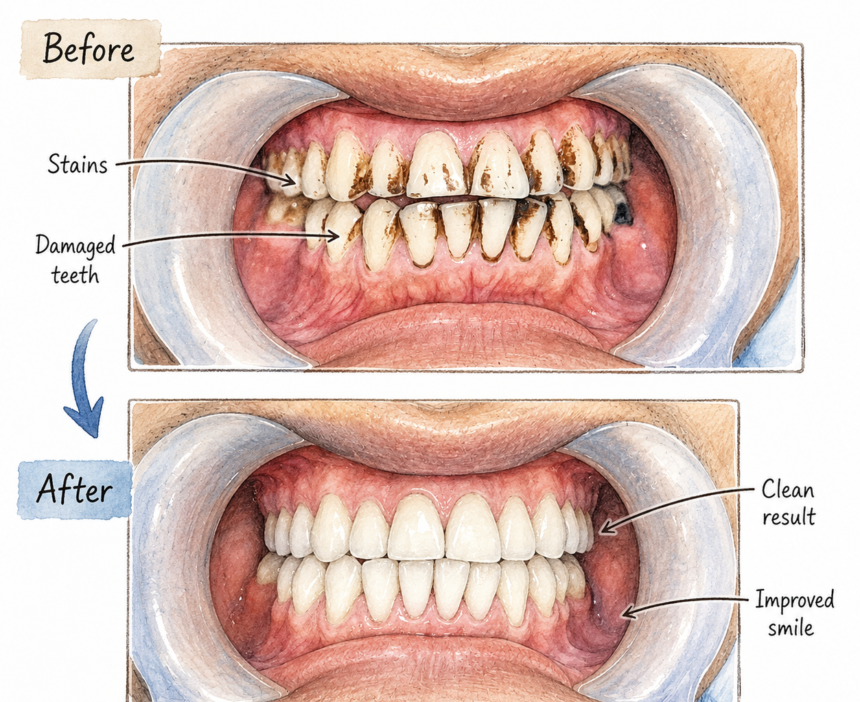
Stained teeth after braces can feel upsetting. Many people wait a long time to see their straight smile, and then they notice white spots, yellow marks, brown stains, or uneven color when the braces come off. This can be frustrating, but it is also a common concern.
Braces themselves do not usually stain teeth. The marks often happen because plaque, food, and acid sit around brackets and wires for too long. Braces create small spaces that are harder to clean. If plaque stays on the enamel, it can pull minerals out of the tooth surface. This may leave chalky white spots, also called white spot lesions or decalcification.
Not every stain after braces is the same. Some stains are on the surface and can be polished away by a dentist. Some white spots are early enamel damage and may need fluoride, remineralizing care, resin infiltration, microabrasion, or cosmetic treatment. Some yellow or brown marks may come from plaque, tartar, food stains, smoking, poor brushing, or older enamel changes that were hidden while braces were on.
The best fix depends on the type of stain. The first step is a dental check. A dentist can tell whether the marks are surface stains, white spot lesions, tartar, early cavities, enamel defects, or something else.
| Main question | Simple answer |
|---|---|
| Do braces stain teeth by themselves? | Usually no |
| What causes white spots after braces? | Plaque and acid around brackets can weaken enamel |
| Can stains be removed after braces? | Some can, but not all stains are the same |
| Can white spots fade? | Some improve, but deep spots may stay without treatment |
| Should you whiten teeth right away? | Ask a dentist first, especially if white spots are present |
| What helps prevent stains? | Careful brushing, flossing, fluoride, water, and regular dental visits |
What Are Stained Teeth From Braces
Stained teeth from braces means the tooth color looks uneven during or after orthodontic treatment. Some people see white square shaped marks around where brackets were placed. Others notice yellowing, brown lines near the gum line, or darker areas between teeth.
The stains may appear when braces are still on, but many people notice them more after braces are removed. This happens because brackets cover part of the tooth surface. When the brackets come off, the full tooth surface is visible again.
The marks may be cosmetic, but some can also be an early warning sign of enamel damage. A white chalky spot may mean minerals have been lost from the enamel. If the cause is not controlled, that area can become a cavity.
| Type of mark | What it may mean |
|---|---|
| Chalky white spot | Enamel mineral loss possible |
| Yellow stain | Plaque, food stain, or tartar possible |
| Brown mark near bracket area | Stain or early decay possible |
| Dark line near gum | Plaque, tartar, or cavity risk |
| Square shaped mark | Color difference around bracket area |
| Rough area | Enamel damage or plaque buildup possible |
| Sensitive spot | Enamel weakness or cavity possible |
Why Stains Show More After Braces Come Off
Brackets cover small parts of the teeth. The uncovered areas are exposed to food, drinks, plaque, and acid during treatment. If those uncovered areas change color, the bracket-covered area may look different when the braces are removed.
Sometimes the covered area looks lighter because it was protected from staining drinks. Sometimes the area around the bracket looks white because plaque sat there and weakened the enamel.
Common reasons stains show more after removal include:
- Brackets were covering part of the enamel
- Plaque collected around brackets
- Food and drinks stained uncovered enamel
- Gum line areas were hard to clean
- Acidic drinks weakened enamel
- White spots were hidden by brackets
- Tartar built up near wires
- The teeth were dry right after braces removal and looked chalkier
| What you notice after removal | Possible reason |
|---|---|
| White squares | Plaque damage around brackets or color contrast |
| Yellow teeth with lighter bracket spots | Food or drink staining on uncovered enamel |
| Brown around gum line | Plaque, tartar, or early decay |
| Chalky patches | Demineralization |
| Rough stains | Plaque or enamel changes |
| Color improves after cleaning | Surface stain was present |
Do Braces Cause Stains
Braces do not usually stain the teeth directly. The brackets and wires do not normally change the enamel color by themselves. The real issue is that braces make cleaning harder. Plaque can sit around brackets, under wires, and near the gum line.
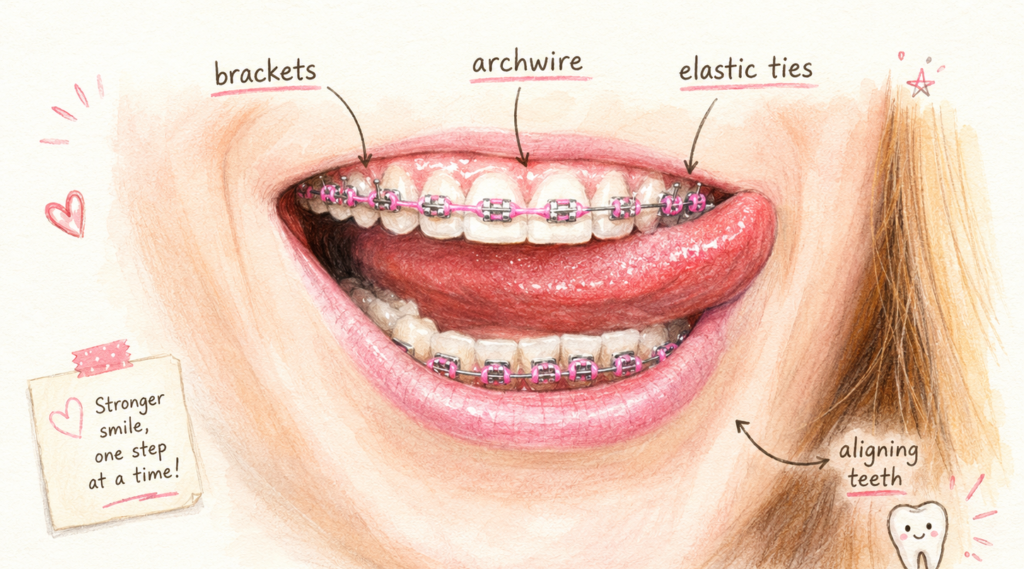
Plaque contains bacteria. When bacteria feed on sugar and starch, they make acid. This acid pulls minerals out of the enamel. Over time, the enamel can become chalky, white, weak, and porous. This is why many braces stains are actually signs of early enamel damage.
Dental care note: Braces do not usually create white spots alone. Plaque left around braces is the main problem.
| Braces part | Why cleaning is harder |
|---|---|
| Brackets | Plaque collects around edges |
| Wires | Food gets trapped under them |
| Bands | Plaque can sit near gum line |
| Elastics | Food and plaque can stick nearby |
| Hooks | Harder to brush around |
| Crowded teeth | Even harder to clean well |
The Bracket Shadow Effect
A useful way to understand braces stains is the bracket shadow effect. The bracket area and the area around it may age differently during treatment. The enamel under the bracket is covered. The enamel around the bracket is exposed to plaque, acid, drinks, and food.
When braces are removed, the covered and uncovered areas may not match. This can make stains look like squares or outlines.
The bracket shadow effect can happen because:
- The bracket protected one area from drinks
- Plaque damaged the uncovered area
- The gum line was harder to clean
- Food sat around bracket edges
- Brushing missed the area above or below brackets
- The teeth were not polished yet after removal
- The enamel was dry and looked extra chalky
| Area | What can happen |
|---|---|
| Under bracket | Often protected from food stains |
| Around bracket | Plaque can collect |
| Near gum line | White spots or yellow buildup may appear |
| Between teeth | Flossing difficulty can cause stains |
| Around bands | Tartar and plaque may build |
| Exposed enamel | Can stain from drinks and foods |
White Spots After Braces
White spots are one of the most common marks people notice after braces. They may look chalky, cloudy, dull, or matte. They may appear around where brackets were placed, near the gum line, or between teeth.
These white spots are often caused by enamel demineralization. This means the enamel has lost minerals because acid stayed on the tooth surface. The enamel may reflect light differently, which makes the spot look white.
White spots are not just a color issue. They can be early tooth decay. If the area keeps losing minerals, it can turn into a cavity.
| White spot feature | What it may mean |
|---|---|
| Chalky look | Mineral loss |
| Matte surface | Enamel surface change |
| Near bracket edges | Plaque sat around bracket |
| Near gum line | Brushing may have missed the area |
| Sensitive to cold or sweets | Enamel may be weak |
| Rough feeling | Active damage possible |
Are White Spots Permanent
Some white spots improve with time, fluoride, saliva, and better cleaning. Others may remain visible. The deeper and longer the mineral loss has been present, the harder it may be to make the spot fade fully.
A dentist may first suggest remineralization care. If the spot still shows after the enamel is stable, cosmetic options may be discussed.
Possible outcomes include:
- Small early spots may fade
- Some spots become less noticeable after saliva rehydrates enamel
- Fluoride may help strengthen early lesions
- Resin infiltration may mask some white spots
- Microabrasion may help selected surface spots
- Bonding may cover deeper marks
- Whitening may help color balance, but should be planned carefully
| White spot stage | Possible outcome |
|---|---|
| Early and smooth | May improve with fluoride and care |
| Chalky but not deep | May partly fade |
| Rough or pitted | Needs dental treatment |
| Brown and white mixed | Decay or stain may be present |
| Sensitive spot | Needs dental check |
| Large visible spot | Cosmetic care may be needed |
Yellow Stains After Braces
Yellow stains after braces can come from plaque, tartar, food stains, drinks, or poor cleaning. The teeth may look yellow overall or yellow near the gum line. Sometimes the area under brackets looks lighter because the rest of the tooth became stained during treatment.
Yellow color does not always mean enamel damage. It may be surface stain that can be cleaned or polished. But if yellow areas are rough, near the gum line, or linked with swelling and bleeding, plaque and tartar may be present.
| Yellow stain source | What it may look like |
|---|---|
| Plaque | Soft yellow film |
| Tartar | Hard yellow or brown buildup |
| Tea or coffee | General yellowing |
| Curry or colored foods | Surface staining |
| Poor brushing | Yellow near gum line |
| Smoking or tobacco | Yellow or brown stains |
| Old enamel color | Natural tooth shade |
What Helps Yellow Stains
The right fix depends on whether the stain is soft plaque, hard tartar, or deeper discoloration. Plaque can often be improved with better brushing. Tartar needs professional cleaning. Food stains may improve with dental polishing or whitening if the teeth are healthy.
Helpful steps include:
- Book a dental cleaning after braces removal
- Brush with fluoride toothpaste
- Clean along the gum line
- Floss or use interdental brushes
- Drink water after stain-causing drinks
- Avoid frequent sugary drinks
- Ask before whitening
- Treat gum swelling or bleeding
- Keep regular dental visits
| Stain type | Best first step |
|---|---|
| Soft yellow film | Better brushing and dental cleaning |
| Hard yellow buildup | Professional tartar removal |
| General yellowing | Dentist-approved whitening after check |
| Gum line stain | Clean gum line and see hygienist |
| Stain with rough enamel | Dentist exam |
| Stain with sensitivity | Dental check before whitening |
Brown Marks After Braces
Brown marks can come from surface stains, tartar, early decay, or deeper enamel changes. Brown near the gum line may happen when plaque and tartar build up. Brown around a bracket area can mean stain or mineral loss that has picked up color.
Brown stains should be checked because they can sometimes mean decay. A dentist can tell whether the mark is surface stain, tartar, or a cavity.
| Brown mark clue | What it may suggest |
|---|---|
| Brown near gum line | Tartar, plaque, or decay risk |
| Brown in grooves | Food stain or cavity possible |
| Brown around bracket area | Stain or enamel damage |
| Brown spot that feels rough | Decay possible |
| Brown between teeth | Flossing area may need X-ray |
| Brown with sensitivity | Dental check needed |
When Brown Marks Need Faster Care
Brown marks are more concerning when they are rough, growing, painful, or sensitive. A mark between teeth may not be fully visible and may need an X-ray.
See a dentist if you notice:
- Brown spot that grows
- Rough or sticky tooth surface
- Sensitivity to cold or sweets
- Food catching in one spot
- Gum swelling or bleeding
- Bad breath that does not improve
- Pain when biting
- Brown spot between teeth
- A hole or pit in the enamel
| Warning sign | Why it matters |
|---|---|
| Sensitivity | Enamel or dentin may be affected |
| Rough spot | Active decay possible |
| Food trapping | Hole or gap possible |
| Growing mark | Needs diagnosis |
| Pain | Cavity or gum issue possible |
| Gum bleeding | Plaque or gum disease possible |
Plaque Around Brackets
Plaque is a sticky film of bacteria that forms on teeth. With braces, plaque can build around brackets and wires because those areas are harder to clean. Plaque may look white, yellow, or fuzzy. It may collect near the gum line and around bracket edges.
Plaque is the main cause of many braces stains. It also raises the risk of cavities and gum inflammation. The longer plaque stays on teeth, the more damage it can cause.
| Plaque location | Why it matters |
|---|---|
| Around bracket edges | White spots may form |
| Under wires | Hard to brush |
| Near gum line | Gum swelling and stains |
| Between teeth | Cavities can start |
| Around bands | Tartar buildup possible |
| Behind lower front teeth | Tartar builds quickly |
How to Spot Plaque With Braces
Plaque can be hard to see, especially if it is thin. Some dental offices use disclosing tablets or dye to show missed areas. You can also look closely after brushing to see if the tooth surface still looks dull or fuzzy.
Signs plaque may be present include:
- Teeth feel fuzzy
- Gum line looks yellow
- Gums bleed when brushing
- Bad breath
- White chalky spots
- Food stays around brackets
- Brackets look cloudy at the edges
- Teeth do not feel smooth after brushing
| Plaque clue | What to do |
|---|---|
| Fuzzy tooth surface | Brush more carefully |
| Bleeding gums | Improve cleaning and see dentist |
| Bad breath | Clean tongue, braces, and between teeth |
| White spots starting | Ask orthodontist or dentist |
| Food trapped often | Use interdental brush or water flosser |
| Yellow gum line | Dental cleaning may be needed |
Tartar and Braces Staining
Tartar is hardened plaque. Once plaque hardens into tartar, brushing cannot remove it fully at home. Tartar often appears yellow, brown, or rough. It can build near the gum line, behind lower front teeth, and around braces.
Tartar can make teeth look stained and can irritate the gums. It can also hold more plaque, which raises the risk of white spots and cavities.
| Tartar feature | What you may notice |
|---|---|
| Hard buildup | Does not brush away |
| Yellow or brown color | Common tartar look |
| Near gum line | Common location |
| Rough feeling | Plaque sticks more easily |
| Gum bleeding | Gum irritation possible |
| Bad breath | Bacteria buildup |
How Tartar Is Fixed
Tartar needs professional removal by a dentist or hygienist. Trying to scrape tartar with home tools can damage enamel and gums.
Professional care may include:
- Dental cleaning
- Scaling around gum line
- Polishing after braces removal
- Fluoride treatment if needed
- Gum check
- Advice for cleaning around braces
- More frequent cleanings during orthodontic treatment if risk is high
| Tartar problem | Best fix |
|---|---|
| Hard yellow buildup | Professional cleaning |
| Brown tartar | Scaling and polishing |
| Bleeding gums | Gum care and better cleaning |
| Tartar around brackets | Orthodontic hygiene review |
| Repeated buildup | More regular cleanings |
Food and Drink Stains With Braces
Some foods and drinks stain enamel more easily, especially if they are taken often. Braces can trap these liquids and food particles near brackets and wires. This can make staining worse if cleaning is not done well.
Stain-causing foods are not always forbidden, but frequency matters. Sipping colored or acidic drinks throughout the day can be worse than having them with a meal.
| Food or drink | Possible effect |
|---|---|
| Tea | Yellow or brown surface stain |
| Coffee | Brown or yellow stain |
| Cola | Acid and color stain |
| Sports drinks | Acid and sugar exposure |
| Curry | Yellow stain |
| Tomato sauce | Acid and color |
| Berries | Color stain |
| Soy sauce | Dark stain |
| Red colored drinks | Surface stain |
| Sugary snacks | Plaque acid risk |
Safer Food and Drink Habits
You do not need to panic about every colored food. The bigger issue is how often the teeth are exposed and how well they are cleaned.
Helpful habits include:
- Drink water after colored drinks
- Avoid sipping sugary drinks all day
- Use a cup, not a straw if orthodontist allows, based on appliance type
- Brush after meals when possible
- Rinse with water if brushing is not possible
- Limit sticky sweets
- Avoid hard foods that break brackets
- Keep colored drinks with meals
- Ask your dentist before whitening products
| Habit | Why it helps |
|---|---|
| Water after meals | Rinses loose color and sugar |
| Less frequent sipping | Reduces acid time |
| Brushing after meals | Removes plaque |
| Avoid sticky foods | Less trapping around braces |
| Regular cleanings | Removes surface stains |
| Fluoride toothpaste | Strengthens enamel |
Acidic Drinks and Enamel Damage
Acidic drinks can soften enamel temporarily. If plaque and acid are already around braces, acidic drinks can make the enamel more vulnerable. Soda, sports drinks, energy drinks, citrus drinks, and some flavored waters can be acidic.
Acid can also make white spots worse because the enamel loses minerals more easily. Sugary acidic drinks are especially risky because they feed plaque bacteria and expose enamel to acid.
| Acidic drink pattern | Why it matters |
|---|---|
| Sipping soda often | Long acid exposure |
| Sports drink during school or sports | Frequent sugar and acid |
| Energy drink use | Acid and sugar risk |
| Lemon water all day | Acid exposure |
| Juice between meals | Sugar and acid |
| Fizzy drinks | Acid can weaken enamel |
Better Drink Choices During Braces
Water is the best everyday drink for braces. Milk may also be tooth-friendly for many people. If you have an acidic drink, keep it with a meal and rinse with water afterward.
Helpful drink tips include:
- Make water the main drink
- Avoid sipping acidic drinks for hours
- Rinse with water after acidic drinks
- Do not brush right away after strong acid if your dentist advises waiting
- Avoid sugary drinks before bed
- Keep sports drinks for true need, not casual sipping
- Ask your dental team about fluoride if you drink acidic drinks often
| Instead of | Better choice |
|---|---|
| Soda all day | Water |
| Energy drink often | Water or dentist-approved choice |
| Juice between meals | Water between meals |
| Sweet tea all day | Unsweetened or water more often |
| Acidic drink before bed | Water |
| Sticky sweet drink | Plain water |
Gum Line Stains During Braces
The gum line is one of the most common places for stains and white spots during braces. This happens because many people brush the bracket but miss the area between the bracket and gum. Plaque sits there and causes gum swelling, bleeding, yellow buildup, or white marks.
The gum line needs special attention because braces make the tooth surface more crowded.
| Gum line problem | What you may notice |
|---|---|
| Plaque at gum line | Yellow or fuzzy band |
| Gum swelling | Puffy gums around braces |
| Gum bleeding | Bleeding when brushing |
| White spots near gums | Demineralization possible |
| Bad breath | Plaque buildup |
| Tartar | Hard rough buildup |
How to Clean the Gum Line With Braces
The brush angle matters. You need to clean above and below the brackets, not only straight across the front.
Helpful steps include:
- Use a soft toothbrush
- Brush above the brackets near the gum line
- Brush below the brackets
- Angle bristles toward the gum line
- Use small gentle movements
- Brush each tooth separately
- Use interdental brushes under wires
- Use floss threaders or orthodontic floss
- Ask the orthodontist to show missed spots
- Use fluoride toothpaste
| Cleaning area | Tool that may help |
|---|---|
| Above brackets | Soft toothbrush |
| Under wires | Interdental brush |
| Between teeth | Floss threader |
| Around brackets | Orthodontic brush |
| Gum line | Angled brushing |
| Hard-to-reach areas | Water flosser as support |
Brushing Mistakes That Cause Stains
Many people brush every day and still get stains because the technique is not enough for braces. Braces need more careful cleaning than teeth without braces. A quick brush may clean the bracket front but miss the enamel around it.
Brushing harder is not the answer. Better angle, more time, and cleaning tools matter more.
| Brushing mistake | Why it causes stains |
|---|---|
| Brushing too fast | Plaque remains |
| Only brushing bracket fronts | Enamel edges stay dirty |
| Missing gum line | White spots and swelling risk |
| Not brushing after meals | Food stays around braces |
| Using worn toothbrush | Bristles clean poorly |
| Brushing too hard | Gum damage |
| Skipping night brushing | Plaque stays during sleep |
Better Brushing Routine With Braces
A better routine is slow, gentle, and complete.
Try this:
- Brush for enough time to clean every bracket area
- Start at the gum line
- Brush above brackets
- Brush directly on brackets
- Brush below brackets
- Brush chewing surfaces
- Brush the inside surfaces
- Clean the tongue
- Check the mirror after brushing
- Use fluoride toothpaste
- Replace toothbrush when bristles bend
| Step | Why it helps |
|---|---|
| Gum line first | Prevents plaque band |
| Above brackets | Cleans hidden enamel |
| Below brackets | Removes food and plaque |
| Inside teeth | Often forgotten |
| Mirror check | Shows missed areas |
| Fluoride toothpaste | Helps enamel repair |
Flossing With Braces
Flossing is harder with braces, but it is still important. Plaque between teeth can cause stains, cavities, and gum swelling. A toothbrush cannot fully clean between teeth.
Floss threaders, orthodontic floss, interdental brushes, and water flossers can help. A water flosser can be useful, but it should not always replace floss unless your dental team says it is enough for your case.
| Tool | How it helps |
|---|---|
| Floss threader | Gets floss under wire |
| Orthodontic floss | Easier for braces |
| Interdental brush | Cleans under wires and gaps |
| Water flosser | Helps remove loose debris |
| Soft picks | May help some spaces |
| Regular floss | Works with threader |
Flossing Tips for Stain Prevention
Flossing may take more time with braces, but it helps protect the areas that brushing misses.
Helpful tips include:
- Floss once daily
- Use a floss threader under the wire
- Move floss gently against each tooth
- Do not snap floss into gums
- Use interdental brushes for bracket edges
- Use water flosser as support if helpful
- Ask the orthodontist to show the best tool
- Keep supplies where you brush
- Do not skip because it feels slow
| Problem | Helpful fix |
|---|---|
| Floss gets stuck | Use orthodontic floss |
| Takes too long | Practice and use threaders |
| Gums bleed | Keep cleaning gently and ask dentist |
| Food under wires | Use interdental brush |
| Bad breath | Add tongue cleaning and flossing |
| White spots forming | Ask dental team quickly |
Fluoride and Stained Teeth From Braces
Fluoride helps strengthen enamel and supports repair of early mineral loss. It cannot always erase white spots, but it can help stop them from getting worse. Your dentist or orthodontist may recommend fluoride toothpaste, fluoride mouth rinse, fluoride varnish, or prescription fluoride depending on your risk.
Fluoride is most helpful when white spots are early and the enamel surface is still intact. Once the enamel has a hole, a filling may be needed.
| Fluoride option | How it may help |
|---|---|
| Fluoride toothpaste | Daily enamel support |
| Fluoride mouth rinse | Extra support for some patients |
| Fluoride varnish | Professional treatment |
| Prescription fluoride toothpaste | Higher-risk patients |
| Fluoridated water | Ongoing support |
| Fluoride gel | Dentist-directed use |
Who May Need Extra Fluoride During Braces
Some people have higher risk for braces stains and white spots. They may need stronger prevention.
Extra fluoride may be discussed if you have:
- Early white spots
- Poor plaque control
- Dry mouth
- Frequent cavities
- Many sugary drinks
- Gum swelling
- Trouble brushing well
- Long orthodontic treatment
- Crowded teeth
- Acidic drink habit
| Risk factor | Why fluoride may help |
|---|---|
| White spots starting | Supports remineralization |
| Frequent cavities | Helps enamel resist acid |
| Dry mouth | Less natural saliva protection |
| Long braces treatment | More time at risk |
| Poor brushing | Higher plaque acid exposure |
| Sugary drinks | More acid attacks |
Can Whitening Fix Stains After Braces
Whitening can help some yellow or surface discoloration, but it is not always the best first step for braces stains. If you have white spots, whitening may make the whole tooth lighter but may not remove the white spot. In some cases, white spots may look more obvious at first.
A dentist should check the teeth before whitening. If enamel is weak, sensitive, or decayed, whitening may cause discomfort or poor results. A dental cleaning is often done first.
| Situation | Whitening advice |
|---|---|
| General yellowing | Whitening may help after dental check |
| White spots | Whitening may not fix the spot |
| Cavities present | Treat cavities first |
| Sensitive teeth | Ask dentist before whitening |
| Gum disease | Treat gums first |
| Surface stains | Cleaning and polishing may help first |
Why Whitening Should Be Planned
Whitening works on tooth color, not enamel repair. If a white spot is caused by mineral loss, it needs a different approach. Whitening may be used later as part of a full cosmetic plan, but it should not be the first guess for every stain.
Better order of care may be:
- Dental exam
- Cleaning and polishing
- Check for cavities
- Fluoride or remineralization plan
- Wait and monitor early white spots
- Consider resin infiltration or microabrasion
- Consider whitening if suitable
- Consider bonding if needed
| First step | Why |
|---|---|
| Dental exam | Finds the stain type |
| Cleaning | Removes plaque and tartar |
| Fluoride | Strengthens weak enamel |
| Waiting period | Some spots fade after braces removal |
| Cosmetic care | Used if spots remain visible |
| Whitening plan | Helps color balance if safe |
Resin Infiltration for White Spots
Resin infiltration is a dental treatment used for some white spot lesions. It works by filling tiny pores inside the white spot with a clear resin. This can make the white spot look closer to the natural tooth color.
This treatment is often used when the enamel surface is not deeply broken. It is not the right choice for every case. A dentist will check whether the spot is suitable.
| Resin infiltration point | Simple meaning |
|---|---|
| Main use | Masks some white spot lesions |
| Best for | Selected early enamel lesions |
| Not for | Deep cavities or large broken enamel |
| Tooth removal | Usually little or no drilling |
| Result | White spot may look less visible |
| Needs dentist | Cannot be done at home |
When Resin Infiltration May Help
Resin infiltration may be discussed after braces are removed and the teeth are cleaned. It may be useful when white spots are visible and do not improve enough with remineralization care.
It may help if:
- White spots are smooth
- Spots are not deep holes
- Cavities are not present
- The person wants a cosmetic improvement
- The dentist confirms the enamel is suitable
- The spots are from demineralization
- Fluoride care has stabilized the teeth
| Good candidate clue | Why it matters |
|---|---|
| Smooth white spot | Surface may be suitable |
| No cavity hole | Resin infiltration may work better |
| Stable enamel | Cosmetic plan is safer |
| Good hygiene | Helps prevent new spots |
| Dentist diagnosis | Confirms the cause |
Microabrasion for White Spots
Microabrasion is a dental treatment that removes a very thin outer layer of enamel to reduce certain surface stains or shallow white spots. It is not for every stain. It works best when the discoloration is close to the surface.
A dentist may suggest microabrasion alone or with other treatments. It must be done carefully because enamel does not grow back.
| Microabrasion point | Simple meaning |
|---|---|
| Main use | Shallow surface stains or spots |
| Removes | Very thin enamel layer |
| Best for | Selected surface defects |
| Not best for | Deep lesions or cavities |
| Done by | Dentist |
| May combine with | Whitening or resin infiltration in selected cases |
Microabrasion Safety Points
Microabrasion should not be done at home. Scrubbing with harsh products can damage enamel and gums.
Important points include:
- Dentist must check stain depth
- Enamel thickness matters
- Cavities must be treated first
- Sensitivity risk should be discussed
- It may not remove deep white spots
- It may be part of a larger cosmetic plan
- Good hygiene is still needed afterward
| Question to ask | Why it helps |
|---|---|
| Is my stain shallow | Checks if microabrasion may work |
| Is enamel healthy enough | Protects tooth structure |
| Will I need whitening too | Plans final color |
| Is resin infiltration better | Compares options |
| What if the spot is deep | May need bonding |
Dental Bonding for Braces Stains
Dental bonding uses tooth-colored resin to cover or repair a visible area. It may be used when white spots, brown stains, chips, or enamel defects do not improve enough with other care. Bonding can improve appearance, but it may stain or wear over time and may need repair.
Bonding is often considered when the stain is deeper or more visible. It is more than a simple cleaning, so a dentist will explain pros and cons.
| Bonding point | Simple meaning |
|---|---|
| Main use | Covers visible stain or defect |
| Material | Tooth-colored resin |
| Best for | Deeper or stubborn visible marks |
| Can stain later | Needs care |
| May need repair | Not permanent forever |
| Done by | Dentist |
When Bonding May Be Needed
Bonding may be considered if:
- White spots are deep
- Brown marks remain after cleaning
- Enamel is pitted
- A cavity has been treated
- Resin infiltration is not suitable
- The person wants cosmetic improvement
- Tooth shape also needs correction
- The stain is on a visible front tooth
| Situation | Why bonding may help |
|---|---|
| Deep visible white spot | Covers color difference |
| Pitted enamel | Smooths and restores surface |
| Brown defect | Covers or repairs area |
| Small chip | Improves shape |
| Uneven front tooth | Cosmetic repair |
| After cavity treatment | Restores tooth structure |
Veneers and Crowns for Severe Stains
Veneers and crowns are usually not the first treatment for braces stains. They are more involved and remove more tooth structure than simple treatments. They may be considered only when stains are severe, enamel is damaged, tooth shape is poor, or other treatments will not give a good result.
A veneer covers the front surface of a tooth. A crown covers more of the tooth. These are dental restorations and need long-term care.
| Treatment | When it may be considered |
|---|---|
| Veneer | Severe front tooth cosmetic issue |
| Crown | Tooth is weak, broken, or heavily restored |
| Bonding | Smaller visible defect |
| Resin infiltration | White spot masking |
| Microabrasion | Shallow stain |
| Whitening | General color improvement |
Why Conservative Care Comes First
It is usually better to save healthy enamel when possible. Many braces stains can be managed with cleaning, fluoride, resin infiltration, microabrasion, or bonding before considering veneers or crowns.
Conservative care matters because:
- Enamel is valuable
- Veneers may need replacement in future
- Crowns remove more tooth structure
- Young patients may need long-term maintenance
- Some white spots improve without major treatment
- A dentist can choose the least invasive option first
| Treatment level | Tooth structure impact |
|---|---|
| Cleaning | No enamel removal |
| Fluoride | No enamel removal |
| Resin infiltration | Very conservative |
| Microabrasion | Removes a thin layer |
| Bonding | Usually conservative |
| Veneer | More tooth preparation |
| Crown | Most tooth coverage |
Can Stains Be Prevented While Wearing Braces
Yes, many braces stains can be prevented. The key is keeping plaque off the teeth every day. Braces make cleaning harder, so the routine needs to be stronger than before braces.
Prevention is easier than fixing white spots later. Once enamel changes happen, treatment can improve appearance, but it may not fully return the tooth to how it looked before.
| Prevention goal | Simple action |
|---|---|
| Remove plaque | Brush carefully around brackets |
| Clean between teeth | Floss or use braces tools |
| Strengthen enamel | Use fluoride toothpaste |
| Reduce acid | Limit sugary and acidic drinks |
| Find early spots | Regular dental visits |
| Stop tartar | Professional cleanings |
| Protect gum line | Angle brush properly |
Daily Braces Stain Prevention Routine
A simple routine is easier to follow when it is clear.
Daily routine:
- Brush in the morning
- Brush after meals when possible
- Brush before bed carefully
- Use fluoride toothpaste
- Clean above and below brackets
- Floss once daily
- Use interdental brush for wires
- Rinse with water after snacks
- Avoid sipping sugary drinks all day
- Check teeth in the mirror after brushing
- Keep dental cleaning visits
- Tell your orthodontist if white spots appear
| Time | What to do |
|---|---|
| Morning | Brush and check gum line |
| After meals | Brush or rinse with water |
| After snacks | Remove trapped food |
| Evening | Full brush and floss routine |
| Before bed | Make sure brackets are clean |
| Dental visits | Ask about white spot risk |
Best Tools for Cleaning Braces
The right tools make braces cleaning easier. You do not need every tool, but you do need a method that cleans all areas. Ask your orthodontist which tools fit your braces and mouth.
| Tool | Best use |
|---|---|
| Soft toothbrush | Main cleaning tool |
| Electric toothbrush | Helps some people clean better |
| Interdental brush | Cleans under wires and around brackets |
| Floss threader | Helps floss under wires |
| Orthodontic floss | Easier flossing with braces |
| Water flosser | Removes loose food and supports gum cleaning |
| Fluoride toothpaste | Enamel support |
| Fluoride rinse | Extra support if advised |
How to Know If Your Tools Are Working
Your cleaning tools are working if your teeth feel smooth, gums bleed less, and plaque is not sitting around brackets. If white spots, swelling, or bad breath continue, your routine may need adjustment.
Signs your routine needs help:
- Plaque still visible after brushing
- Gums bleed often
- Brackets look cloudy
- Food remains under wires
- Bad breath continues
- White spots are starting
- Yellow tartar is forming
- Toothbrush bristles wear quickly
- You avoid flossing because it is too hard
| Problem | Tool that may help |
|---|---|
| Food under wire | Interdental brush |
| Hard flossing | Floss threader |
| Gum bleeding | Better gum line cleaning |
| White spots | Fluoride and dentist review |
| Bad breath | Tongue cleaning and flossing |
| Tartar | Professional cleaning |
What to Do If You See Stains While Braces Are Still On
Do not wait until braces come off if you see white spots, yellow buildup, brown marks, or gum swelling. Early action can stop stains from getting worse. Tell your orthodontist and dentist.
The orthodontist may show you missed areas, suggest fluoride, adjust your cleaning plan, or send you for a dental cleaning. In higher-risk cases, treatment may be paused if hygiene is poor.
| What you see | What to do |
|---|---|
| White spots around brackets | Tell orthodontist quickly |
| Yellow buildup | Book dental cleaning |
| Brown mark | Dentist check |
| Bleeding gums | Improve cleaning and get gum check |
| Bad breath | Review hygiene routine |
| Food always trapped | Ask for tool advice |
| Sensitive spot | Dentist exam |
Early Action Plan
Acting early can protect enamel.
Helpful steps include:
- Take a photo to track changes
- Tell your orthodontist
- Book dental cleaning
- Improve brushing around brackets
- Add flossing tools
- Ask about fluoride varnish or rinse
- Reduce sugary drinks
- Avoid sticky snacks
- Drink more water
- Do not try harsh whitening at home
| Early action | Why it helps |
|---|---|
| Tell orthodontist | Gets guidance before damage worsens |
| Dental cleaning | Removes plaque and tartar |
| Fluoride | Supports enamel |
| Better brushing | Stops acid sitting on teeth |
| Diet changes | Reduces acid attacks |
| Avoid whitening | Prevents uneven results while braces are on |
What to Do After Braces Come Off
After braces come off, your teeth may feel smooth but look uneven in color. Do not rush into whitening or harsh products. The first step is usually cleaning, polishing, and checking for white spots or cavities.
Teeth can also look extra chalky right after braces removal because enamel may be dry. The appearance may change after saliva rehydrates the teeth.
| After braces step | Why it matters |
|---|---|
| Dental exam | Checks enamel and cavities |
| Cleaning and polishing | Removes surface stains |
| Fluoride treatment | Supports weak enamel |
| Wait and monitor | Some spots look different over time |
| Cosmetic planning | Matches treatment to stain type |
| Retainer cleaning | Prevents new stains |
Safe After-Braces Plan
A safe plan may include:
- See dentist after braces removal
- Get professional cleaning
- Ask if spots are surface stain or white spot lesions
- Ask about fluoride
- Avoid whitening until dentist checks teeth
- Keep brushing and flossing daily
- Clean retainers daily
- Take photos to monitor spots
- Ask about resin infiltration if white spots remain
- Ask about bonding if spots are deep
| Concern | Best first step |
|---|---|
| Yellow teeth | Cleaning and dentist check |
| White spots | Fluoride and treatment discussion |
| Brown marks | Check for decay or tartar |
| Sensitive teeth | Dentist review before whitening |
| Rough areas | Check enamel damage |
| Retainer smell | Clean retainer daily |
Retainers and New Stains
After braces, retainers help hold teeth in place. But retainers can also trap plaque if teeth and retainers are not clean. Clear retainers can hold saliva, bacteria, and food residue against teeth. This may lead to bad breath, stains, or cavity risk if hygiene is poor.
Retainers must be cleaned every day. Teeth should be brushed before wearing them, especially after snacks or sugary drinks.
| Retainer issue | What can happen |
|---|---|
| Dirty retainer | Bad smell and bacteria |
| Wearing after sugary drinks | Sugar trapped on teeth |
| Not brushing before retainer | Plaque held against enamel |
| Hot water cleaning | Retainer can warp |
| Leaving retainer out | Teeth can shift |
| Poor storage | Germ buildup |
Retainer Cleaning Tips
Follow your orthodontist’s instructions because retainer types differ.
Helpful tips include:
- Brush teeth before wearing retainers
- Rinse retainer after removal
- Clean retainer daily
- Use cool or lukewarm water if advised
- Do not use hot water
- Keep retainer in its case
- Do not wrap it in tissue
- Avoid sugary drinks while wearing clear retainers
- Bring retainer to dental visits
- Replace if cracked or smelly despite cleaning
| Retainer habit | Why it helps |
|---|---|
| Clean daily | Reduces bacteria |
| Brush before wearing | Prevents trapped plaque |
| Use case | Prevents loss and germs |
| Avoid heat | Keeps shape |
| No sugary drinks with retainer | Reduces cavity risk |
| Dental checks | Keeps fit and hygiene safe |
Are Braces Stains Cavities
Some braces stains are not cavities. Surface stains and tartar are different from tooth decay. But white spots from demineralization can be early decay. Brown or rough spots may also be cavity warning signs.
A dentist can check the surface, use X-rays if needed, and decide whether treatment is needed.
| Mark type | Is it a cavity |
|---|---|
| Surface yellow stain | Usually not, but needs cleaning |
| Tartar | Not a cavity, but raises risk |
| White spot lesion | Early decay possible |
| Brown rough spot | Cavity possible |
| Hole or pit | Cavity likely |
| Sensitive dark spot | Needs dental exam |
Signs a Stain May Be More Than Cosmetic
Get a dental check if the stain comes with symptoms.
Warning signs include:
- Tooth sensitivity
- Pain with sweets
- Pain when biting
- Rough or sticky spot
- Visible hole
- Food catching
- Brown spot growing
- Gum swelling
- Bad breath that does not improve
- Bleeding gums
| Symptom | Why it matters |
|---|---|
| Sweet sensitivity | Decay possible |
| Rough surface | Enamel may be damaged |
| Food catching | Hole or gap possible |
| Growing brown spot | Needs diagnosis |
| Pain | Cavity or nerve issue possible |
| Bleeding gums | Plaque or gum disease |
Stains Before Braces That Become Visible Later
Some stains were present before braces but become more noticeable after teeth move. Crowded teeth can hide white spots, yellow patches, or enamel defects. When braces straighten the teeth, hidden areas may become visible.
This can make it look like braces caused the stain, even when the mark was already there. A dentist can help tell the difference.
| Before braces issue | Why it shows later |
|---|---|
| Crowding | Hidden enamel becomes visible |
| Old white spots | Teeth move into clearer view |
| Enamel hypoplasia | Defect becomes easier to see |
| Fluorosis | White patches become more noticeable |
| Old tartar | Exposed after alignment |
| Uneven wear | More visible after straightening |
How to Tell If Stains Were Old
It is not always easy to know. Photos before treatment can help. Orthodontic records may show older marks. Your dentist can also look at the pattern.
Clues a stain may be old include:
- It is not shaped around a bracket
- It is on a tooth that was crowded
- It matches a known enamel defect
- It appears on teeth without brackets
- It was visible in old photos
- It looks like fluorosis or enamel hypoplasia
- It does not match plaque patterns
| Clue | Possible meaning |
|---|---|
| Stain not near bracket | May not be braces-related |
| Same mark in old photo | Pre-existing spot |
| Symmetrical white marks | Fluorosis possible |
| Pitted enamel | Enamel defect possible |
| Stain on hidden tooth surface | Crowding may have hidden it |
Gum Health and Stained Teeth From Braces
Gum swelling can make teeth look stained because plaque collects near puffy gum tissue. Swollen gums can also cover parts of the teeth. When braces come off and gums heal, the tooth color and shape may look different.
Gum health is important during braces because gums can bleed, swell, and trap plaque if not cleaned well.
| Gum problem | How it affects tooth color |
|---|---|
| Swollen gums | Plaque hides near gum line |
| Bleeding gums | Inflammation present |
| Gum recession | Root surface may look yellow |
| Tartar near gums | Yellow or brown buildup |
| Bad breath | Bacteria buildup |
| Tender gums | Brushing may be avoided |
How to Support Gum Health With Braces
Gum care should be gentle but complete.
Helpful steps include:
- Brush the gum line daily
- Floss or use braces tools
- Use interdental brushes
- Keep dental cleanings
- Avoid smoking or tobacco
- Drink water
- Reduce sugary snacks
- Tell your dentist about bleeding
- Do not avoid brushing because gums bleed
- Ask for help if gums stay swollen
| Gum care step | Why it helps |
|---|---|
| Gum line brushing | Removes plaque band |
| Flossing | Reduces between-teeth bacteria |
| Dental cleaning | Removes tartar |
| Water | Helps rinse food |
| Less sugar | Reduces plaque acid |
| Professional advice | Finds gum disease early |
Unique Insight: The Three-Zone Braces Cleaning Rule
A helpful way to prevent stains is to think of every bracket as having three cleaning zones. Many people only clean the middle zone, which is the bracket front. The stain risk often sits in the top and bottom zones where plaque collects.
The three zones are the gum side, the bracket side, and the chewing edge side. Each zone needs brush contact.
| Zone | What to clean |
|---|---|
| Gum side | Area between gum and bracket |
| Bracket side | Around bracket edges |
| Chewing edge side | Area below or above bracket toward biting edge |
| Under wire | Food and plaque around wire |
| Between teeth | Flossing area |
| Back of teeth | Often missed |
How to Use the Three-Zone Rule
Use the mirror and clean each tooth in sections.
Steps include:
- Brush the gum side of every bracket
- Brush directly around every bracket
- Brush the chewing edge side of every bracket
- Use an interdental brush under the wire
- Floss between teeth once daily
- Check for dull or fuzzy areas
- Rinse with water after meals
- Ask your orthodontist to check your cleaning
| If you miss this zone | What may happen |
|---|---|
| Gum side | White spots near gums |
| Bracket edges | Square marks |
| Under wire | Food stain and plaque |
| Between teeth | Hidden cavities |
| Back of teeth | Tartar and bad breath |
| Chewing edge | Plaque buildup |
Practical Example: White Squares After Braces
A teen gets braces removed and sees white square-like marks around where the brackets were. The teeth do not hurt, but the marks look chalky. This may be demineralization from plaque around the bracket edges.
The safest plan is a dental exam, cleaning, fluoride support, better home care, and waiting to see how the spots change. If the spots remain visible, resin infiltration or other cosmetic treatments may be discussed.
| Sign | Possible meaning |
|---|---|
| White square outline | Plaque damage around brackets |
| Chalky surface | Enamel mineral loss |
| No pain | Still needs check |
| Near gum line too | Cleaning may have missed areas |
| Looks worse when dry | Enamel dehydration may make it show |
Practical Example: Yellow Teeth After Braces
Another person has yellow-looking teeth after braces, but no white spots. The teeth feel smooth after a dental cleaning and look brighter after polishing. This may have been surface stain from drinks and plaque.
In this case, whitening may be considered after a dentist confirms the teeth and gums are healthy.
| Sign | Possible meaning |
|---|---|
| General yellow color | Surface stain or natural shade |
| No chalky spots | Less likely white spot lesions |
| Improves after cleaning | Stain was on surface |
| No sensitivity | Whitening may be possible after check |
| Healthy gums | Better whitening candidate |
Common Myths About Stained Teeth From Braces
There are many myths about braces stains. Some people think braces glue causes all stains. Others think stains always disappear after brushing. Some think whitening fixes every mark. These ideas can lead to wrong care.
| Myth | Truth |
|---|---|
| Braces directly stain teeth | Plaque and acid are usually the problem |
| White spots always go away | Some may stay without treatment |
| Whitening fixes white spots | It may not and can sometimes make contrast noticeable |
| Brushing harder removes spots | Hard brushing can hurt gums |
| Tartar can be removed at home | It needs professional cleaning |
| Stains are only cosmetic | Some are early decay |
| Retainers cannot stain teeth | Dirty retainers can trap plaque |
Better Ways to Think About Braces Stains
A better way is to separate stains by type. Surface stains, tartar, white spot lesions, and cavities need different care.
Better thinking includes:
- Identify the stain type first
- Clean and polish before cosmetic treatment
- Use fluoride for early enamel weakness
- Do not whiten before dental check
- Do not scrub hard
- Protect gum line daily
- Keep retainers clean after braces
- Ask early if spots appear during treatment
| Old thinking | Better thinking |
|---|---|
| All stains are the same | Stain type matters |
| I should whiten right away | Dentist check comes first |
| Braces ruined my teeth | Plaque control is usually the key |
| Scrubbing will fix spots | Gentle complete cleaning is safer |
| White spots are harmless | They can be early decay |
| Retainers are simple | Retainer hygiene matters |
When to See a Dentist
You should see a dentist if you notice stains during braces or after braces removal. Early care gives the best chance of protecting enamel. Do not wait until braces come off if you see chalky white areas around brackets.
See a dentist or orthodontist if you notice white spots, yellow tartar, brown marks, sensitivity, gum bleeding, rough enamel, or bad breath that does not improve.
| Reason to book a visit | Why |
|---|---|
| White spots around brackets | Early enamel damage possible |
| Brown marks | Stain or cavity possible |
| Yellow hard buildup | Tartar needs cleaning |
| Gum bleeding | Plaque or gum inflammation |
| Sensitivity | Enamel may be weak |
| Rough spots | Decay possible |
| Bad breath | Plaque buildup |
| Stains after braces | Needs diagnosis before whitening |
Urgent Dental Signs
Most braces stains are not emergencies, but some signs need quicker care.
Call a dentist soon if you have:
- Tooth pain
- Swelling in gum or face
- Pus
- Fever with dental pain
- A hole in the tooth
- Severe sensitivity
- Brown spot growing quickly
- Food stuck in a hole
- Bleeding gums that do not improve
- Broken bracket trapping food badly
| Urgent sign | Best action |
|---|---|
| Tooth pain | Dental check |
| Swelling | Urgent dental care |
| Pus | Infection concern |
| Fever with tooth pain | Urgent care |
| Visible hole | Dentist soon |
| Severe sensitivity | Dental exam |
Final Thoughts
Stained teeth from braces can happen, but braces themselves are usually not the direct cause. The most common reason is plaque sitting around brackets, wires, and the gum line. When plaque stays too long, bacteria make acid that pulls minerals out of enamel. This can cause chalky white spots. Yellow or brown stains may come from plaque, tartar, food, drinks, or early decay.
The best fix depends on the stain type. Surface stains may improve with cleaning and polishing. Tartar needs professional removal. Early white spots may need fluoride and careful home care. Stubborn white spots may be improved with resin infiltration, microabrasion, bonding, or other dentist-guided treatment. Whitening may help general yellowing, but it should be planned after a dental exam.
Prevention is the best approach. Clean above and below every bracket, floss daily with braces tools, use fluoride toothpaste, drink water, limit sugary and acidic drinks, keep dental cleanings, and tell your orthodontist early if white spots appear. After braces, keep retainers clean and continue strong oral care.
| Final takeaway | Simple meaning |
|---|---|
| Braces do not usually stain teeth directly | Plaque around braces is the main cause |
| White spots can be early decay | They need attention |
| Yellow stains may be surface stains | Cleaning may help |
| Brown spots need checking | Decay is possible |
| Fluoride supports enamel | It can help early mineral loss |
| Whitening is not always first | Dentist check comes first |
| Prevention is easier than repair | Clean carefully every day |
Simple Closing Checklist
Ask yourself these questions if you are worried about braces stains:
- Do I see chalky white spots?
- Are stains near brackets or gum line?
- Do my gums bleed when brushing?
- Do my teeth feel fuzzy after brushing?
- Do I drink sugary or acidic drinks often?
- Do I floss with braces tools?
- Do I use fluoride toothpaste?
- Have I had a dental cleaning during braces?
- Are there brown or rough spots?
- Do I feel sensitivity?
- Are my retainers clean?
- Have I asked my dentist before whitening?
| If your answer is yes | Best next step |
|---|---|
| White spots | Ask dentist about enamel mineral loss |
| Yellow buildup | Book cleaning |
| Brown marks | Dental check for decay |
| Gum bleeding | Improve cleaning and see dentist |
| Frequent sugary drinks | Reduce sipping and rinse with water |
| Poor flossing | Use braces tools |
| Sensitivity | Get dental exam |
| Want whitening | Ask dentist first |